Questions to Ask in an Interview: Final Round, HR and Sales
By Mustafa Tarabya, founder of CVBooster · Published · Updated
10 min read
The best questions to ask in an interview depend on who is across the table. Ask HR about pay, process and policy, ask the hiring manager about the work and how it is judged, and ask in the final round about the first ninety days and why the seat is open. The constraint is time. You usually get three or four questions, so each one has to return information you cannot find on the careers page. CareerOneStop, the U.S. Department of Labor's career site, tells candidates to "Make a list of questions that you would like to ask during the interview." Eight question sets follow: one per stage, one for sales interviews, and a ranked list of the ten best with the five and three to keep if time runs short, each with what a good answer sounds like. Written by Mustafa Tarabya, who hired for his own company, read every application himself and now writes CVBooster's guides.
"Do you have any questions for us?" sounds like the door. It is the last scored round, wearing a coat.
Questions to ask in an HR interview
The HR or recruiter screen is about logistics and constraints. Recruiters know the salary band, the process and the policies, and they will share them. Ask them about culture and you get a brochure.
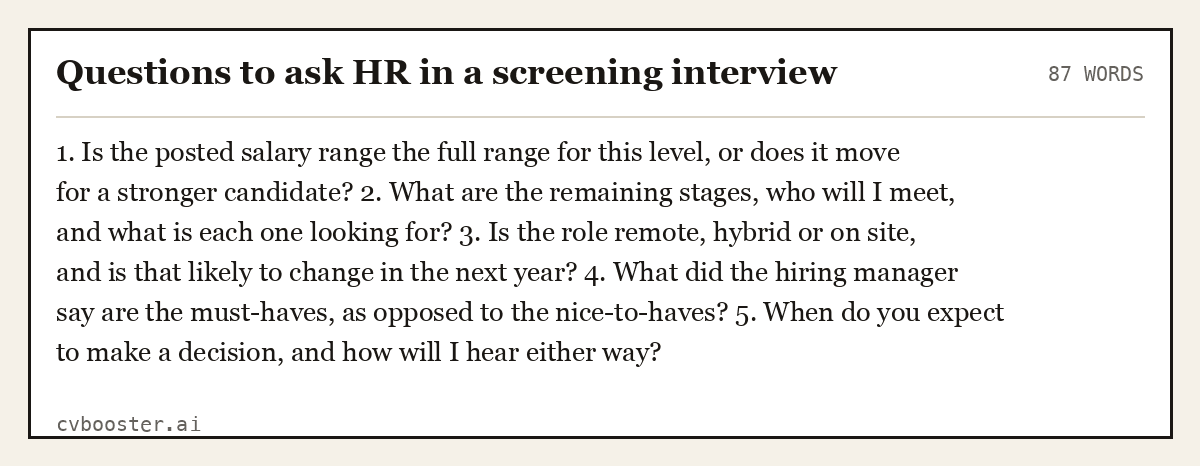
Questions to ask HR in a screening interview (87 words)
1. Is the posted salary range the full range for this level, or does it move for a stronger candidate? 2. What are the remaining stages, who will I meet, and what is each one looking for? 3. Is the role remote, hybrid or on site, and is that likely to change in the next year? 4. What did the hiring manager say are the must-haves, as opposed to the nice-to-haves? 5. When do you expect to make a decision, and how will I hear either way?
How to read the answers: a recruiter who can say what each stage evaluates is working with a designed process. One who cannot is running interviews on instinct, and the decision will be too.
If you need an adjustment for the interview itself, HR is the right person to ask. The EEOC states that "Employers are explicitly prohibited from making pre-offer inquiries about disability", which is why the request is yours to raise, not theirs.
Questions to ask the hiring manager
The manager is the person you would work for. You get one hour to judge that, so spend most of your questions here. CareerOneStop suggests asking about the job itself, starting with "What are the day-to-day responsibilities of this job?" and "How will my responsibilities and performance be measured? By whom?"
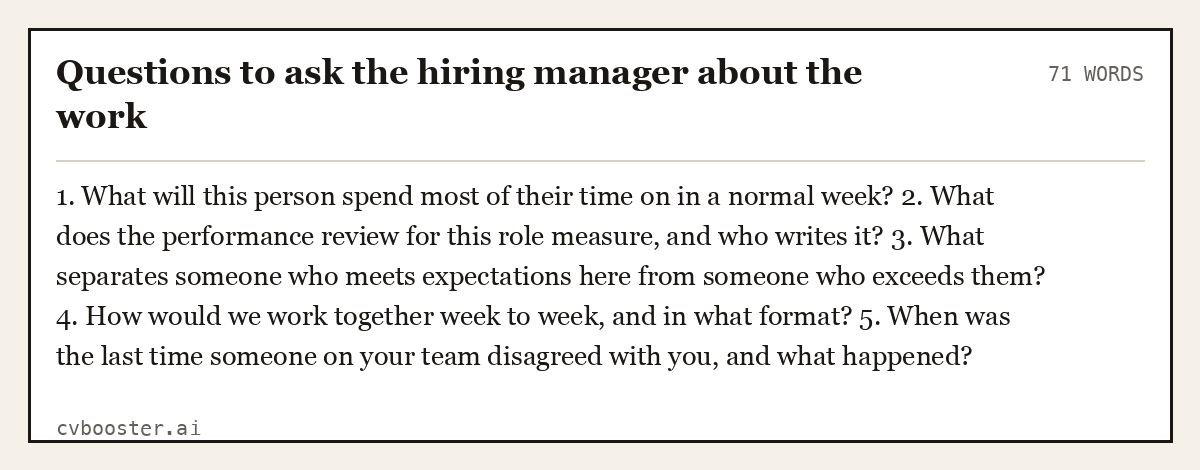
Questions to ask the hiring manager about the work (71 words)
1. What will this person spend most of their time on in a normal week? 2. What does the performance review for this role measure, and who writes it? 3. What separates someone who meets expectations here from someone who exceeds them? 4. How would we work together week to week, and in what format? 5. When was the last time someone on your team disagreed with you, and what happened?
How to read the answers: specific beats fluent. A manager who names a project, a metric or a person is describing something that exists. "My door is always open" means no structure, so you get attention when something is on fire and none otherwise. If the review answer drifts into "ownership" and "being proactive", your raise is a judgment call.
Questions to ask a panel
A panel has several people and little time. Ask questions any of them can answer, then notice who answers.
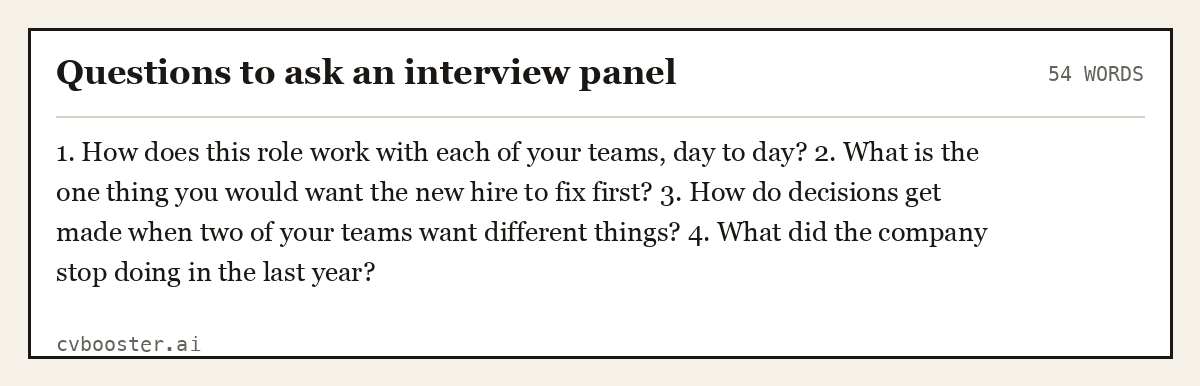
Questions to ask an interview panel (54 words)
1. How does this role work with each of your teams, day to day? 2. What is the one thing you would want the new hire to fix first? 3. How do decisions get made when two of your teams want different things? 4. What did the company stop doing in the last year?
How to read the answers: if the panel members describe success differently, that gap is your finding. You would be reporting into it. An organization that can name something it stopped doing has a working way of choosing priorities.
Questions to ask in a final interview
The final round is often with a senior leader. They will not discuss the salary band, but they will talk about direction, and they decide.
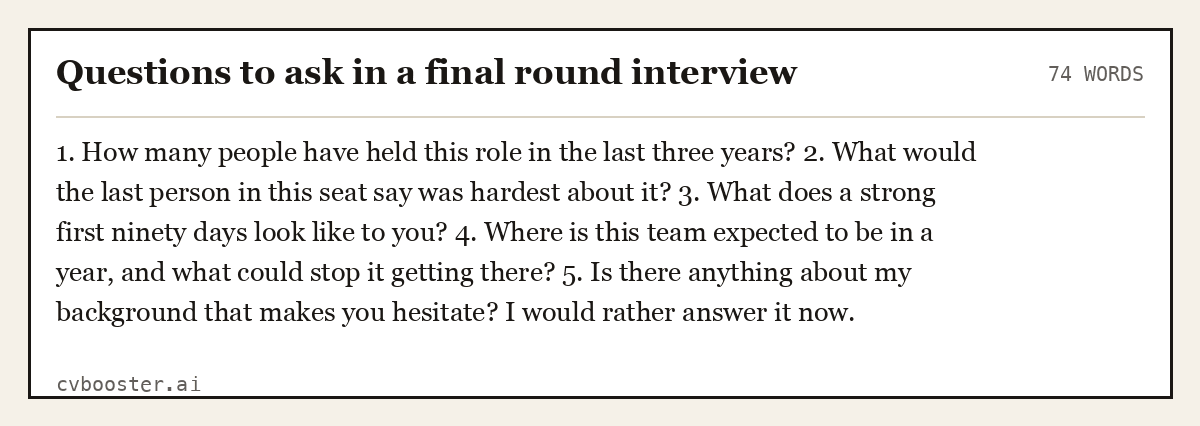
Questions to ask in a final round interview (74 words)
1. How many people have held this role in the last three years? 2. What would the last person in this seat say was hardest about it? 3. What does a strong first ninety days look like to you? 4. Where is this team expected to be in a year, and what could stop it getting there? 5. Is there anything about my background that makes you hesitate? I would rather answer it now.
How to read the answers: one person in three years, promoted, is healthy. Three people in three years is not turnover. That is a broken role. Question five feels risky, but it gives you the only chance to answer a doubt before the debrief.
Questions to ask at the end of any interview
When you only get one question, ask the one that ends on the work.
Best questions to ask an interviewer when you only get one or two (56 words)
1. What would have changed in twelve months if this hire went well? 2. You mentioned the team is taking on new reporting work. How settled is that, and would it sit with this role? 3. You have answered everything I came in with. What would you want to see from me in the first month?
How to read the answers: question two only works if it comes from something the interviewer said that day. Write down two such things during the interview. They beat anything you prepared at home.
Questions to ask the interviewer in a sales interview
A sales manager hires on numbers, so ask about the numbers. The answers tell you whether the quota is reachable before you sign up to carry it.
Questions to ask the interviewer in a sales interview (85 words)
1. What percentage of the team hit quota last year, and what did the top performers do differently? 2. How is the territory or account list assigned, and does a new hire inherit live accounts or start cold? 3. How long is the typical sales cycle from first call to signed contract? 4. How is commission paid: on booking, on invoice or on cash received, and is there a cap? 5. What does ramp look like, and is the quota reduced in the first quarter?
How to read the answers: if nobody can tell you how many reps hit quota, either it is low or nobody tracks it, and both matter. A manager who answers question four in detail without checking a document has paid a lot of commission and is proud of it.
Questions to ask at an internal job interview
At an internal job interview you already know the company, so the questions to ask move from what the business does to how the move will work: what the new manager needs from an internal candidate, how your current work gets handed over, and what happens to your standing if you are not chosen. These six do that without sounding as though you are negotiating your exit:
- What would you need to see from an internal candidate that you would not need from an outside hire?
- How would my current projects be handed over, and what start date is realistic once the backfill is planned?
- What does this team need that it does not get from my current department today?
- Which of my existing working relationships would help in this role, and which would need resetting?
- Has anyone on the team moved in from another department, and what made their first three months work?
- If I am not chosen this time, what would make me the stronger candidate for the next opening?
How to read the answers: question one tells you whether the panel scores internal and external candidates on the same sheet. Question six is safe internally in a way it is not outside, because you will still be in the building next month. Tell your current manager before the interview if your company policy expects it. The internal cover letter and internal resume guides cover the paperwork that comes before this conversation.
The 10 best questions to ask an employer during an interview, and the top 5 and top 3 to keep
Prepared lists run long and interviews run short. Rank yours before you walk in, so you know which ones survive when the interviewer says there are five minutes left. The ten below are ranked: if you get five, ask the first five; if you get three, ask the first three.
Ten best questions to ask an interviewer, ranked (133 words)
1. What would the person in this role spend most of a normal week doing? 2. How will you judge whether this hire was a success at six months? 3. How many people have held this role in the last three years? 4. What is the biggest problem this team needs the new hire to take off your desk? 5. Is there anything about my background that makes you hesitate? 6. Who would I work with most closely, and how do decisions get made between you? 7. What does a strong first ninety days look like? 8. How does the team handle a disagreement about priorities? 9. What is the team working on next quarter that this role would touch? 10. What are the next steps, and when do you expect to decide?
How to read the list: the first three cover the work, the measure and the turnover, which is why they are the three to keep when time is tight. So if someone asks you what the top 3 questions to ask an interviewer are, it is these: what the person in the role does in a normal week, how success is judged at six months, and how many people have held the job in three years. The top 5 adds the problem the new hire takes off the manager's desk and "Is there anything about my background that makes you hesitate?" Question five is the one most candidates skip and the one most likely to change the debrief, because it gives you a chance to answer a doubt before the panel meets without you.
Questions to ask after the interview, by email
Some answers arrive after the interview. Good after interview questions are about the job, not about how you did: one question you ran out of time for and one about the timeline. One short email, sent the same or next day, is enough.
Follow-up questions to ask after a job interview (48 words)
Thank you for your time today. One question I did not get to ask: how does the team measure the first quarter for a new hire in this role? Also, could you confirm when you expect to make a decision? I am still very interested in the position.
CareerOneStop also tells candidates to "Ask when the employer plans to make a decision." Ask it in the room if you can. For the thank-you note itself, see the thank you letter guide. If the conversation felt flat, our guide to the signs your interview went bad separates the real warning signs from nerves.
What not to ask, and why
- Anything on the careers page or in the posting. It reads as though you did not read what you were given.
- Vacation and hours before an offer. Not because wanting them is wrong. HR sends that policy in writing anyway.
- "What is the culture like?" The answer is the same everywhere. Ask how disagreements get settled instead.
- "Why did they fire the last person?" No safe answer exists. The turnover count gets the same signal.
- "How did I do?" It asks someone to commit before a debrief they have not had.
Your own answers matter as much as your questions. The common interview questions and answers page covers the twenty you will be asked, job interview tips covers the day itself, and how to prepare for an interview covers the evening before. If salary comes up, how to negotiate salary shows what to say.
Frequently asked questions
What are good questions to ask in an HR interview?
Ask HR about the salary range, the remaining interview stages and what each one looks for, whether the role is remote or on site, what the hiring manager called the must-haves, and when they will decide. HR knows process and policy, so keep questions about the daily work for the hiring manager.
What questions can be asked to the interviewer?
Anything about the job, the team, how the work is measured, the hiring process and the next steps. The best ones return facts you cannot find online: what the role does in a normal week and how many people have held it in three years. Leave pay and leave for HR or the offer stage.
What questions should I ask in a final interview?
Ask about the turnover in the role, what the last person found hardest, what a strong first ninety days looks like, where the team should be in a year, and whether anything in your background makes them hesitate. The last one gives you a chance to answer a doubt before the decision.
How many questions should you ask in an interview?
Prepare eight and expect to ask three or four, then one or two more after the interview if something was left open. Several will be answered during the interview, so cross them off and say so. Add one question based on something the interviewer said that day, because it shows you were listening rather than waiting.
What are the top 5 questions to ask an interviewer?
Ask what the role does in a normal week, how success is judged at six months, how many people have held the role in three years, what problem the new hire should take off the manager's desk, and whether anything in your background gives them pause. If you only get three, keep the first three.
What should you not ask in a job interview?
Avoid questions answered in the posting, vacation and hours before an offer, "what is the culture like", questions about why the last person was fired, and "how did I do". Each one either wastes a slot or puts the interviewer in a position where no honest answer is safe.
Related articles
- Job Interview Tips: A Timeline From Preparation to Follow-Up
- Leadership Interview Questions and 12 Full Sample Answers
- Case Manager Interview Questions: 7 Answers That Score
- Creative Interview Questions With 6 Sample Answers
More articles
- Real Cost of Resume Builders: the four-weekly billing trick
- Receptionist Job Descriptions for a Resume: 9 Examples
- Recommendation Letter for Student: 7 Samples and a Guide
Looking for a worked example for your job title? Browse the resume examples by job title.