Resume Synonyms: Better Words for 10 Tired Resume Verbs
By Mustafa Tarabya, founder of CVBooster · Published · Updated
11 min read
The best resume synonym is the verb that says exactly what you did: "ran" instead of "managed" if you ran the store, "trained" instead of "helped" if you trained the new hires, and a plain verb instead of "responsible for" every time. A synonym is not there to sound clever. It is there to replace a vague word with a specific one. Somewhere a thesaurus turned a stock clerk's "helped customers" into "abetted patrons", and that resume went straight into the no pile. The one constraint: never swap the words the job ad uses. CareerOneStop, the US Department of Labor's career site, says it plainly: "Use the exact terms in your resume. Any variation from what's written in the job posting may fail to be recognized as a qualification." Below are the ten words that tire a reader fastest, their synonyms, and six before and after bullet sets from entry level to senior. Written by Mustafa Tarabya, who hired for his own company, read every application himself and now writes CVBooster's guides.
Synonyms for managed on a resume
"Managed" is the most common verb on any pile of resumes, and it hides the size of the job. Did you manage people, a budget, a process or a calendar? Pick the synonym that answers that question.
- People: led, supervised, directed, coached, hired, scheduled
- Money: ran a budget of, controlled, allocated, cut, negotiated
- Projects: delivered, coordinated, launched, planned, oversaw
- Operations: ran, opened, closed, organized, maintained
- Clients and accounts: handled, served, retained, grew, renewed
- Systems and records: administered, maintained, configured, audited, updated
If you are looking for a synonym for manage on a resume for your current job, use the same verbs in the present tense: lead, oversee, run, coordinate, administer. Past jobs take the past tense, and the current one stays in the present so the reader can tell at a glance what you still do. Keep "manage" itself once if the job ad uses it, because the posting's own word is the one a tracking system matches.
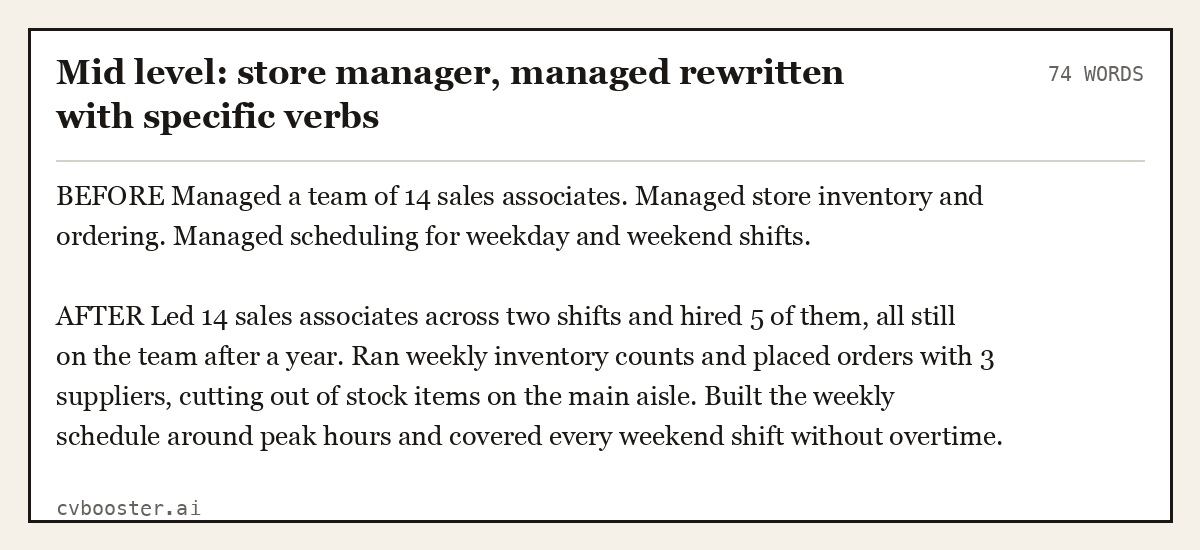
Mid level: store manager, managed rewritten with specific verbs (74 words)
BEFORE Managed a team of 14 sales associates. Managed store inventory and ordering. Managed scheduling for weekday and weekend shifts.
AFTER Led 14 sales associates across two shifts and hired 5 of them, all still on the team after a year. Ran weekly inventory counts and placed orders with 3 suppliers, cutting out of stock items on the main aisle. Built the weekly schedule around peak hours and covered every weekend shift without overtime.
What to say instead of responsible for
"Responsible for" describes the job ad you were hired from, not the work you did. Delete it and start with the verb that follows. "Responsible for payroll" becomes "Processed payroll for 60 staff every two weeks." If you need a replacement phrase, use owned, handled, ran or delivered, but a plain past tense verb is almost always better.
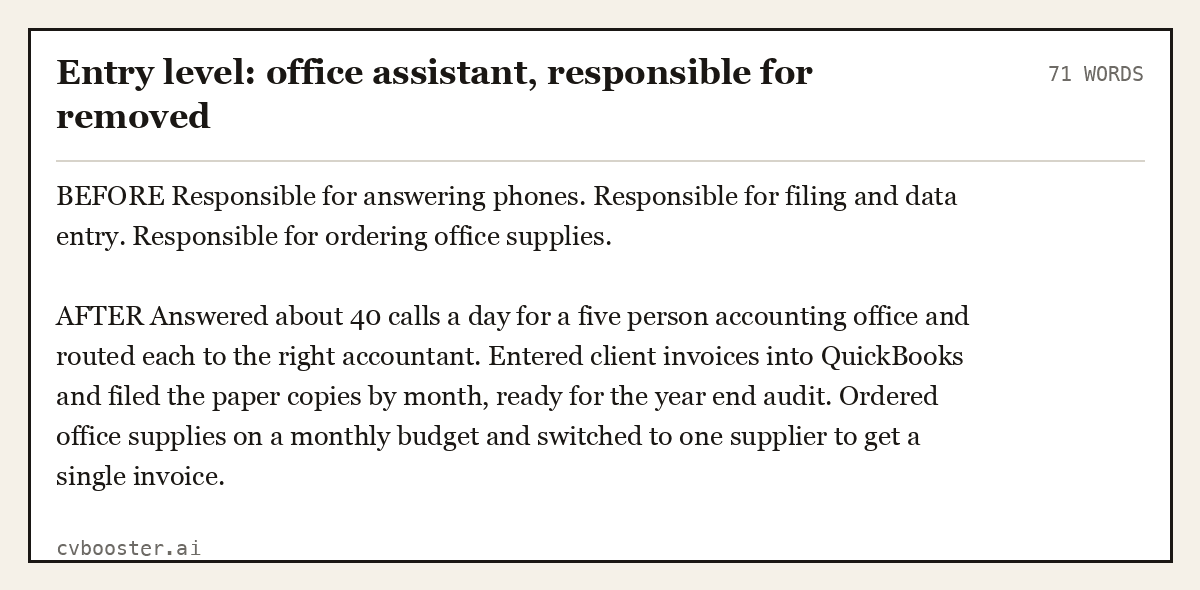
Entry level: office assistant, responsible for removed (71 words)
BEFORE Responsible for answering phones. Responsible for filing and data entry. Responsible for ordering office supplies.
AFTER Answered about 40 calls a day for a five person accounting office and routed each to the right accountant. Entered client invoices into QuickBooks and filed the paper copies by month, ready for the year end audit. Ordered office supplies on a monthly budget and switched to one supplier to get a single invoice.
Synonyms for helped and assisted
"Helped" makes the reader ask what you actually did while somebody else did the work. Name your part: supported, trained, prepared, researched, drafted, set up, answered, processed. If you shared the work, say so with "with": "Prepared the grant budget with the finance lead."
Work synonyms for a resume: worked on and worked with
"Worked on" is a placeholder. Replace it with what you did to the thing: built, tested, wrote, designed, fixed, repaired, installed, reviewed. "Worked with" becomes partnered with, reported to, advised or served, depending on who the other person was.
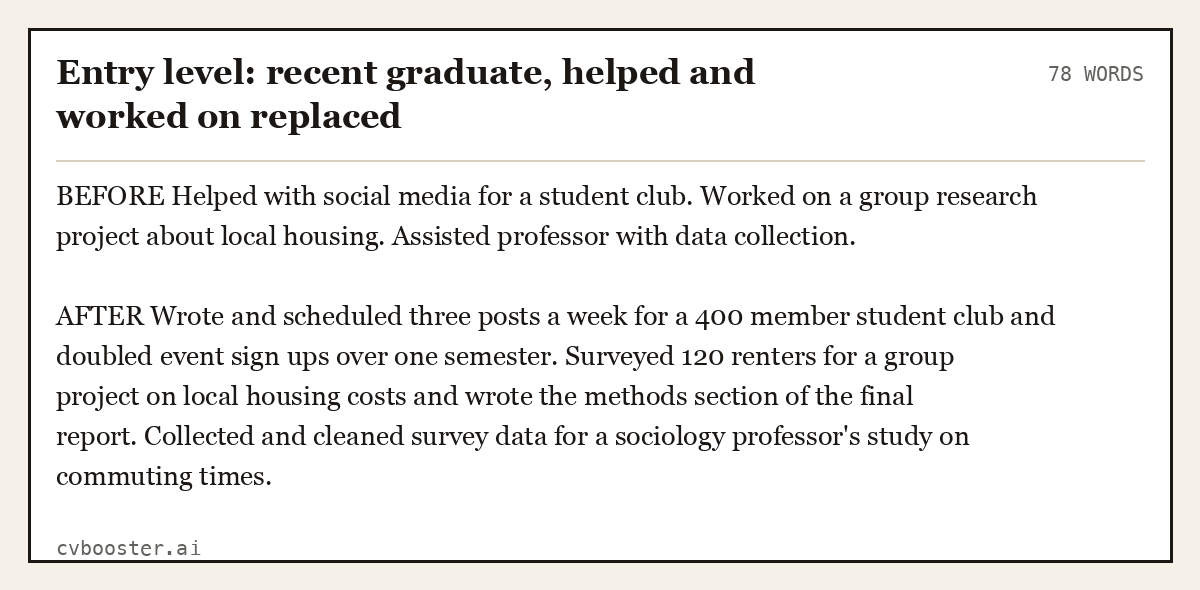
Entry level: recent graduate, helped and worked on replaced (78 words)
BEFORE Helped with social media for a student club. Worked on a group research project about local housing. Assisted professor with data collection.
AFTER Wrote and scheduled three posts a week for a 400 member student club and doubled event sign ups over one semester. Surveyed 120 renters for a group project on local housing costs and wrote the methods section of the final report. Collected and cleaned survey data for a sociology professor's study on commuting times.
If the word you keep reaching for is work itself, as in worked at, work experience or hard work, the swap depends on the meaning: served, staffed or was employed as for where you worked; experience, history or employment for the noun; and a result or a number instead of hard work, because no synonym proves effort as well as an outcome does.
Synonyms for created and made
"Created" is fine once. By the fourth bullet it reads like a template. A good created synonym on a resume names the kind of thing you made, so pick the verb from the object, not from a thesaurus:
- Systems, tools and teams: built, set up, assembled, stood up.
- Layouts, processes and courses: designed, drafted, mapped.
- Reports, procedures and guides: wrote, authored, documented.
- Products, campaigns and services: launched, introduced, rolled out.
- Training, programs and partnerships: developed, established, founded.
- Videos, events and newsletters: produced, organized, hosted.
"Founded" and "established" belong only to things that did not exist before you. "Launched" needs an audience: a product launched to customers, a campaign launched to the public. If nobody outside your team saw it, "built" or "set up" is the honest verb.
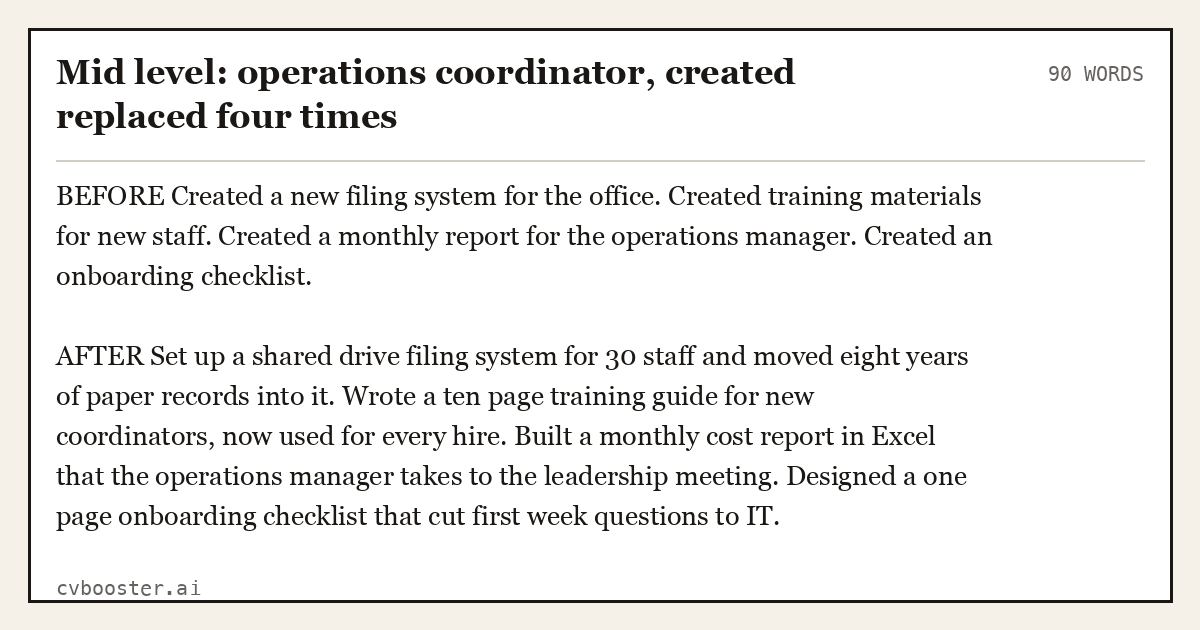
Mid level: operations coordinator, created replaced four times (90 words)
BEFORE Created a new filing system for the office. Created training materials for new staff. Created a monthly report for the operations manager. Created an onboarding checklist.
AFTER Set up a shared drive filing system for 30 staff and moved eight years of paper records into it. Wrote a ten page training guide for new coordinators, now used for every hire. Built a monthly cost report in Excel that the operations manager takes to the leadership meeting. Designed a one page onboarding checklist that cut first week questions to IT.
Synonyms for improved
"Improved" promises a result and then does not show it. Swap it for the verb that names the direction of the change, then add the before and after: cut, reduced, shortened, raised, increased, sped up, simplified, fixed. "Improved the onboarding process" becomes "Shortened new hire onboarding from three weeks to eight days by writing a one page checklist."
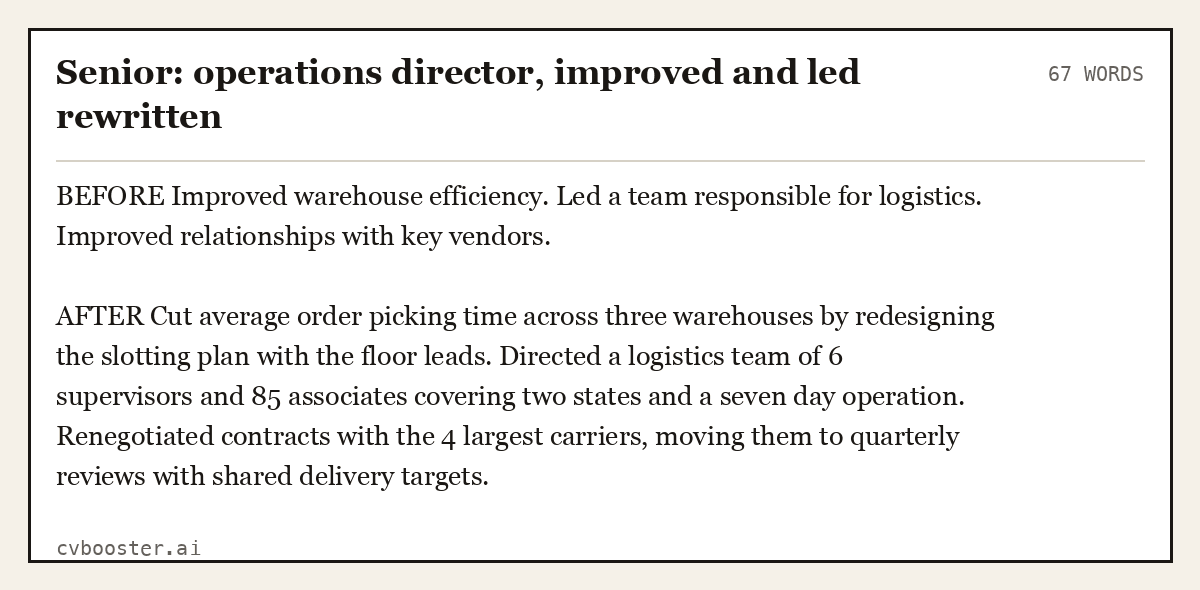
Senior: operations director, improved and led rewritten (67 words)
BEFORE Improved warehouse efficiency. Led a team responsible for logistics. Improved relationships with key vendors.
AFTER Cut average order picking time across three warehouses by redesigning the slotting plan with the floor leads. Directed a logistics team of 6 supervisors and 85 associates covering two states and a seven day operation. Renegotiated contracts with the 4 largest carriers, moving them to quarterly reviews with shared delivery targets.
Lead synonyms for a resume: led, achieved and handled
"Led" is a good verb, so it gets overused. Rotate it with headed, chaired, directed, guided, mentored or ran, and keep "led" for the bullet where you truly carried the team. "Achieved" usually needs no replacement at all: state the result and let it stand. MIT Career Advising gives the reason to start each line with a verb: "Begin each bullet point statement or phrase with an action verb that points the reader to the skill you are trying to highlight." "Handled" becomes resolved, processed, answered or escalated, depending on what happened.
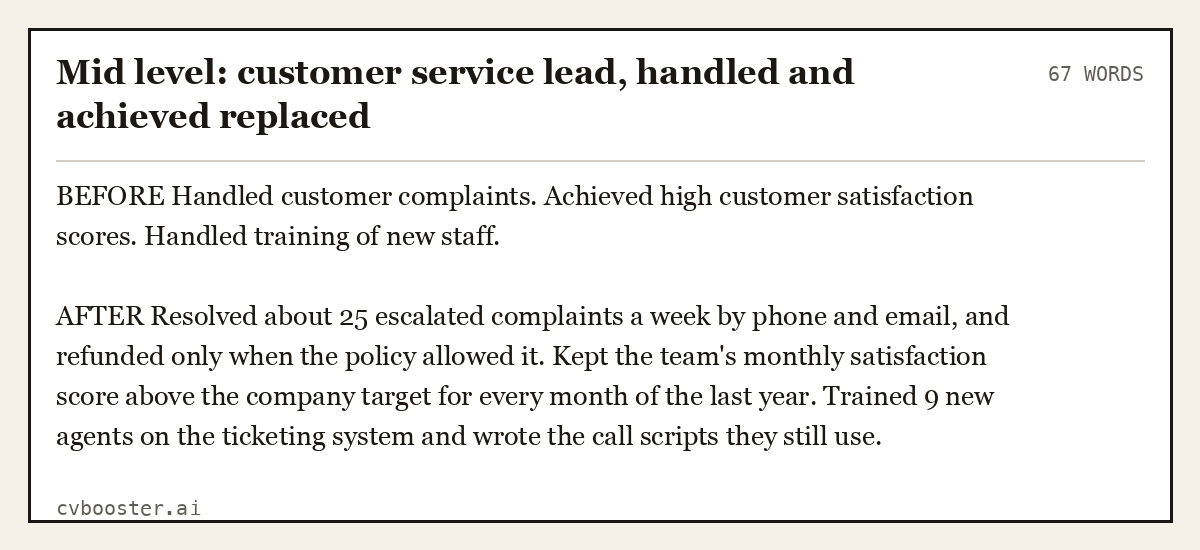
Mid level: customer service lead, handled and achieved replaced (67 words)
BEFORE Handled customer complaints. Achieved high customer satisfaction scores. Handled training of new staff.
AFTER Resolved about 25 escalated complaints a week by phone and email, and refunded only when the policy allowed it. Kept the team's monthly satisfaction score above the company target for every month of the last year. Trained 9 new agents on the ticketing system and wrote the call scripts they still use.
Pick the lead synonym by what you led. People: supervised, coached, mentored, directed. A project: headed, ran, steered, coordinated. A change: spearheaded, drove, launched, piloted. A meeting or committee: chaired, convened. Then give the size, such as a team of six, a three-site rollout or a twelve-person committee, so the verb has something to carry.
Synonyms for team player, detail oriented and communication skills
These are adjectives pretending to be skills, and no synonym saves them. Replace each one with the action that proves it: "detail oriented" becomes "Reconciled 300 vendor statements a month with no payment errors in two years." "Strong communication skills" becomes "Wrote the weekly update read by 40 staff." Put the proof in a bullet and drop the adjective.
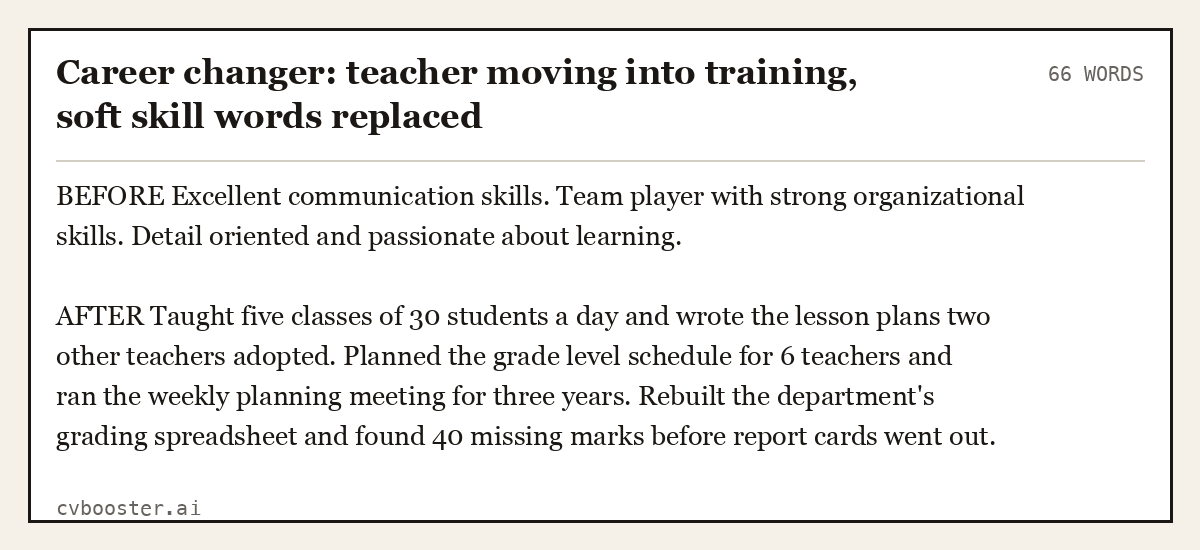
Career changer: teacher moving into training, soft skill words replaced (66 words)
BEFORE Excellent communication skills. Team player with strong organizational skills. Detail oriented and passionate about learning.
AFTER Taught five classes of 30 students a day and wrote the lesson plans two other teachers adopted. Planned the grade level schedule for 6 teachers and ran the weekly planning meeting for three years. Rebuilt the department's grading spreadsheet and found 40 missing marks before report cards went out.
Another word for skills on a resume
The usual words for skills on a resume are abilities, competencies, expertise, strengths, capabilities, proficiencies and qualifications. Each one has a job. "Expertise" and "proficient in" suit deep, tested knowledge, "competencies" suits a list in a formal or public sector application, and "strengths" suits a summary sentence. Use them in the summary and in bullets, where repeating "skills" three times in two lines gets tiring.
The section heading is the exception. Keep the word skills in it, because tracking systems and recruiters look for that heading. "Skills" alone works, and so do "Technical Skills", "Skills and Certifications" or "Core Skills". "Areas of Expertise" and "Core Competencies" read well, but put them on a resume only if the posting uses them or you add "Skills" next to them.
- Summary sentence: "brings expertise in", "strengths include", "proficient in", "qualified in"
- Formal or government application: competencies, qualifications, knowledge, skills and abilities
- Section heading: Skills, Technical Skills, Skills and Certifications, Core Skills and Competencies
- Never: talents, gifts, superpowers. They read as casual, and no recruiter searches for them.
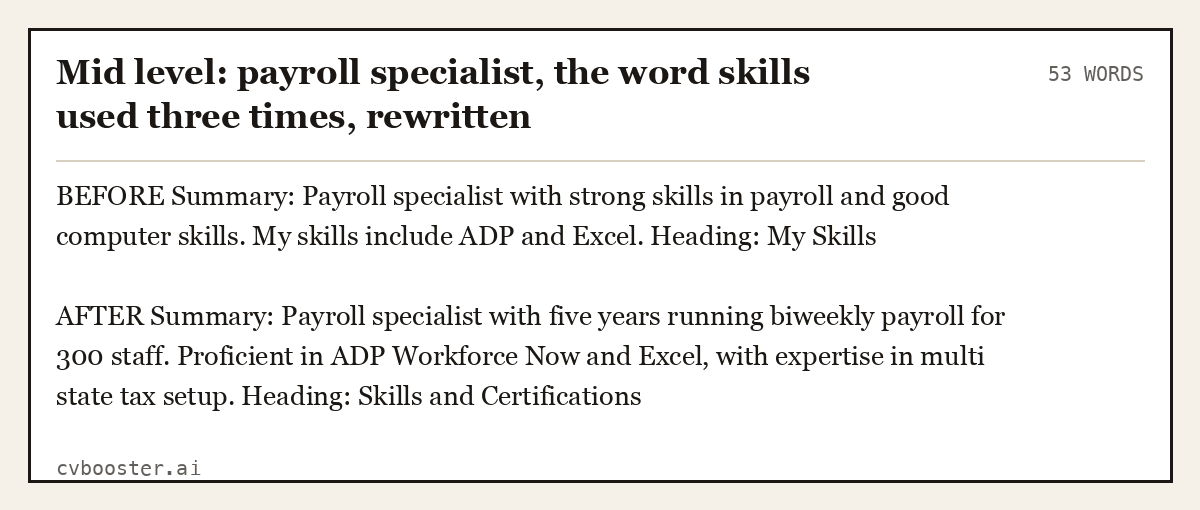
Mid level: payroll specialist, the word skills used three times, rewritten (53 words)
BEFORE Summary: Payroll specialist with strong skills in payroll and good computer skills. My skills include ADP and Excel. Heading: My Skills
AFTER Summary: Payroll specialist with five years running biweekly payroll for 300 staff. Proficient in ADP Workforce Now and Excel, with expertise in multi state tax setup. Heading: Skills and Certifications
Another word for developed on a resume
Another word for developed on a resume depends on what you developed, because "developed" covers four different jobs: making a thing, writing a plan, growing people and winning business. Name the job and the verb picks itself:
- A product, tool or system you made: built, designed, engineered, coded, prototyped.
- A plan, policy or process you wrote: drafted, wrote, mapped, formulated, standardized.
- People you grew: trained, coached, mentored, taught, onboarded.
- Business or relationships you grew: won, opened, expanded, grew, secured.
- A program that did not exist before: established, founded, launched, piloted.
Keep "developed" when the job ad uses it for a skill, such as "develop training curricula", because that phrase is the keyword. Elsewhere, a bullet that starts with "Developed" usually hides the more interesting verb two words later.
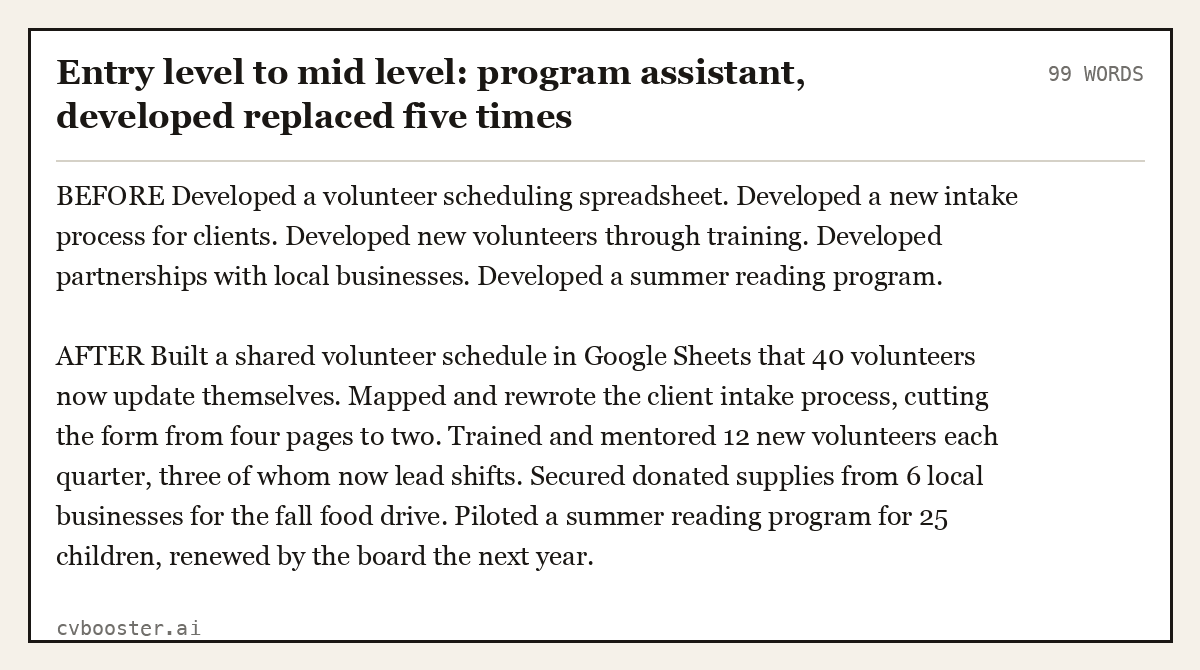
Entry level to mid level: program assistant, developed replaced five times (99 words)
BEFORE Developed a volunteer scheduling spreadsheet. Developed a new intake process for clients. Developed new volunteers through training. Developed partnerships with local businesses. Developed a summer reading program.
AFTER Built a shared volunteer schedule in Google Sheets that 40 volunteers now update themselves. Mapped and rewrote the client intake process, cutting the form from four pages to two. Trained and mentored 12 new volunteers each quarter, three of whom now lead shifts. Secured donated supplies from 6 local businesses for the fall food drive. Piloted a summer reading program for 25 children, renewed by the board the next year.
When not to use a synonym
Three rules keep synonyms from hurting you.
- Keep the job ad's words. If the posting says "inventory management", write "inventory management" somewhere on the page, even if you also write "ran weekly counts". Applicant tracking systems and recruiters match on the exact term.
- Keep it plain. The USAJOBS resume help page puts it this way: "Use plain language. Avoid using acronyms and terms that are not easily understood." A thesaurus word nobody uses at work is harder to read than the tired word it replaced.
- Keep it true. "Spearheaded" means you started it and led it. If you joined halfway through, "supported the launch" is the honest verb and it holds up in the interview.
For full verb lists sorted by skill, see our resume action verbs guide. The same swaps work in the top section of the page, which our professional summary for a resume guide covers, and if you are rewriting an old career into new words, the career change resume page shows how. Shorter verbs also free up space, which helps when you are working out how to make a one page resume.
Frequently asked questions
What is another word for skills on a resume?
Abilities, competencies, expertise, strengths, capabilities, proficiencies or qualifications, depending on the sentence. Use them in the summary and bullets, and keep "Skills" in the section heading itself so a tracking system and a recruiter find it. If you are looking for another word for the resume itself, our another word for resume guide covers CV, curriculum vitae and the rest.
What is a good synonym for manage or managed on a resume?
It depends on what you managed. For people use led, supervised or coached; for money use controlled or allocated; for projects use delivered, coordinated or launched; for daily operations use ran or organized. Then add the size: how many people, how much budget, how many sites. The number does more work than the verb.
What can I say instead of responsible for on a resume?
Usually nothing: delete the phrase and start with the verb that follows it. "Responsible for payroll" becomes "Processed payroll for 60 staff every two weeks." If a sentence truly needs a replacement, owned, handled, ran or oversaw work, but a plain past tense verb is shorter and tells the reader what you did.
What is another word for created or developed on a resume?
Choose by what you made: built or set up for systems and tools, designed for layouts, wrote or drafted for plans and guides, launched for products and campaigns, trained or coached when you developed people, won or expanded when you developed business. Use founded or established only for something that did not exist before you started it.
How many times can I use the same verb on a resume?
Try not to use any verb more than twice on one page, and never start two bullets in a row with the same word. Repetition is not a rule a system checks, but a reader notices it within a few lines and starts to skim. Scan the first word of every bullet before you send the resume.
Should I use synonyms for the keywords in a job description?
No. Copy the job ad's own words for skills, tools, licenses and job titles, because recruiters and tracking systems search for the exact term. Use synonyms only for the verbs and connecting words around those keywords, so the page reads naturally while the matching terms stay intact.
Related articles
- Leadership Skills Examples: 12 Skills and the Resume Lines
- Product Management Keywords: 48 Terms and 6 Resume Examples
- Summa Cum Laude: Meaning and How to List It on a Resume
- Things to Put on a Resume: 9 Sections With Examples
More articles
- Resume in Past Tense or Present: The Rule and 6 Examples
- Resume Translation: How to Translate Your Resume Right
- Resume With a Picture: Should You Include a Photo?
Looking for a worked example for your job title? Browse the resume examples by job title.