Teaching Supporting Statements That Get Shortlisted
By Mustafa Tarabya, founder of CVBooster · Published · Updated
13 min read
You have found the post on Teaching Vacancies, downloaded the application pack, and opened a document that has nothing to do with the CV you spent a weekend on. There is a form. It wants every job you have held since you left school, with reasons for any gaps, and two referees, one of whom must be your current headteacher. Near the end there is a box, or a two page limit, labelled supporting statement, personal statement or letter of application depending on who wrote the pack. The deadline is noon on Friday, and nobody has told you what the person reading it actually ticks.
This is not schools being awkward. The shape of a UK teaching application is set by statutory safeguarding guidance, and once you see the rules underneath the form, the statement stops being a creative writing exercise. Everything below applies to England unless stated, with a separate section on Wales.
Why the school will not take your CV on its own
The controlling document is Keeping Children Safe in Education, the Department for Education statutory guidance for schools and colleges in England. The 2025 version is in force until 31 August 2026, and the 2026 version comes into force on 1 September 2026. Part three covers safer recruitment, and paragraph 293 is blunt: schools should only accept copies of a curriculum vitae alongside an application form, because a curriculum vitae on its own will not provide adequate information.
Paragraph 292 then lists what the application form has to collect. Read this list carefully, because the last item is your supporting statement, described in the guidance itself:
- Personal details, current and former names, current address and National Insurance number.
- Details of present or last employment and the reason for leaving.
- Full employment history since leaving school, including education, employment and voluntary work, including reasons for any gaps in employment.
- Qualifications, the awarding body and the date of award.
- Details of referees and references.
- A statement of the personal qualities and experience that the applicant believes are relevant to their suitability for the post advertised, and how they meet the person specification.
That final line is the whole brief. Not your teaching philosophy. Not a warm paragraph about the school ethos. Qualities and experience relevant to this post, and how you meet the person specification. If your draft does not visibly do those two things, it is off brief however well it reads.
The person specification is the marking scheme
Every pack contains a job description and a person specification. The specification splits criteria into essential and desirable and names how each is assessed: application form, interview, lesson observation, references. Anything assessed at application is a line on a shortlisting grid. Paragraph 298 says at least two people should carry out shortlisting, and that those who shortlist should ideally also interview. So two colleagues, often the head and a deputy, sit with the grid and your statement and tick.
A tick needs something to land on. If the criterion is experience of a validated systematic synthetic phonics programme, saying you are passionate about early reading earns nothing. Naming the programme, the year group and what happened to the lowest group earns the tick.
Tip: Before you write a word, paste the person specification into a two column table. Left: each criterion assessed at application. Right: the strongest piece of evidence you own for it, with a number, a name or a date attached. Any blank row is a row you will lose.
Structure it against the Teachers Standards
The Teachers Standards came into effect on 1 September 2012, with a terminology update in December 2021. They apply in England, define the minimum level of practice expected from the award of qualified teacher status, and are used to assess trainees, early career teachers at the end of induction, and teachers under the appraisal regulations. Part One is teaching. Part Two is personal and professional conduct, used by the Teaching Regulation Agency in serious misconduct cases. The eight Part One headings are:
- Set high expectations which inspire, motivate and challenge pupils.
- Promote good progress and outcomes by pupils.
- Demonstrate good subject and curriculum knowledge.
- Plan and teach well structured lessons.
- Adapt teaching to respond to the strengths and needs of all pupils.
- Make accurate and productive use of assessment.
- Manage behaviour effectively to ensure a good and safe learning environment.
- Fulfil wider professional responsibilities.
Do not label eight paragraphs TS1 to TS8. That reads as a training file rather than an application, and it forces you to pad the standards where your evidence is thin. Group them into four or five headed sections a shortlister can skim: subject and curriculum knowledge for standards 3 and 4, impact on progress for standards 1, 2 and 6, adaptive teaching for standard 5, behaviour for standard 7, contribution beyond your classroom for standard 8. Then check every person specification criterion sits inside one of those sections. Anything the standards do not cover, such as a named exam board or curriculum scheme, gets its own short paragraph.
Evidence, not adjectives
The failure that keeps strong teachers off shortlists is writing claims instead of evidence. A claim is a sentence you could paste into any application. Evidence is a sentence only you could write: the context, what you did, what changed.
- Instead of I have high expectations of all learners: in my Year 4 class I replaced mixed ability tables with daily same day intervention in maths for the lowest attaining group, and by the summer assessment point that group had closed most of the gap to age related expectations.
- Instead of I use assessment effectively: I rebuilt Year 10 mock feedback around a question level analysis sheet, which showed we were losing most marks on the six mark extended response, and wrote a four lesson sequence the department adopted.
- Instead of I am committed to inclusion: I hold responsibility for eight pupils with EHCPs, review their one page profiles with the SENCO each term, and changed my scaffolding so two of them came off adult support in written tasks.
Use your own real detail. Numbers you cannot defend at interview are worse than none, because paragraph 301 tells the school to compare your form against the reference and take up any discrepancies with you.
Safeguarding is a shortlisting line, not a closing sentence
Packs carry a safeguarding statement in the advert because paragraph 289 tells schools to state the commitment to safeguarding, the safeguarding responsibilities of the post, and whether it is exempt from the Rehabilitation of Offenders Act 1974. Person specifications then carry a criterion on understanding of safeguarding and child protection, assessed at application. Candidates answer it with one closing sentence: I am committed to safeguarding and promoting the welfare of children. That sentence is on every application in the pile.
Write a short paragraph showing you have read Part one of Keeping Children Safe in Education, which all school staff are expected to read in full. The 2026 version removes references to the withdrawn condensed Annex A for exactly that reason. Concretely: say what you do when a child discloses, that you report to the designated safeguarding lead rather than investigating yourself, that you do not promise confidentiality, that you record and act on your own concern rather than assuming a colleague has, and that safeguarding issues overlap and rarely arrive labelled.
Tip: One correction to forum advice: do not volunteer your criminal record history in the form or the statement. Paragraphs 294 to 296 say the self declaration is requested from shortlisted candidates, and paragraph 295 states that it should not be requested in the application form to decide who is shortlisted. A form that asks before shortlisting is departing from the guidance, not testing you.
The employment history section is part of the assessment
People treat the history section as admin and the statement as the real application. Shortlisters do the opposite. Paragraph 298 tells them to consider inconsistencies and look for gaps and the reasons given for them, and paragraph 304 tells interviewers to probe gaps or frequent changes of employment or location.
- Give month and year, not year alone. Year only dates manufacture gaps that do not exist.
- Cover everything since you left school, including education, work outside teaching and voluntary work. That is the guidance wording, not a preference.
- Explain gaps in one factual line each. Parental leave, caring responsibilities, ill health, travel, redundancy, study, unsuccessful job search. None disqualifies you. An unexplained blank does the damage.
- Name the reason for leaving each post plainly: end of fixed term contract, relocation, promotion, restructure.
- Keep supply work in, with agency, phases covered and period. Cutting it to tidy the form creates a gap you then explain twice.
References and online searches happen earlier than you expect
Paragraph 300 says schools should obtain references before interview where possible, so concerns can be explored with the referee and then with you. Paragraph 301 adds that schools should not accept open to whom it may concern references, should not rely on you to obtain them, and should take the reference from your current employer, confirmed by the headteacher where the referee is school based. If you have worked with children before but are not now, they will also go back to that employer. Plan for your current head being contacted between the closing date and the interview, and tell them before the form goes in.
Paragraph 299 covers the check people forget. As part of shortlisting, schools should consider a search via an online search engine as due diligence on shortlisted candidates, and should tell them it may happen. Before you submit, search your own name plus your town and subject, and look at what a headteacher sees on the first page.
Early career teachers: writing a statement from one placement
If you are applying for your first post, your evidence base is two or three placements and you cannot fake a track record. You do not need one. Statutory induction in England runs for the full time equivalent of two standard school years, usually six terms, under the guidance Induction for Early Career Teachers (England), last updated on 9 June 2026. Schools hiring an early career teacher read for specificity and coachability, not scale.
- Name the year groups, key stages and settings, including anything distinctive such as a mixed age class, a sixth form group or an alternative provision placement.
- Name the schemes and specifications you actually taught: the phonics programme, the maths scheme, the exam board and specification code.
- Give one sequence you designed yourself, with the assessment evidence you used to judge it. One well told example beats four thin ones.
- Say what you did with mentor feedback. Standard 8 expects you to improve teaching by responding to advice, and this is the closest an ECT gets to proving it.
Wales runs a different system
Most online advice treats England and Wales as one market. They are not. Keeping Children Safe in Education applies to England. The equivalent in Wales is Keeping Learners Safe, issued by the Welsh Government to local authorities, governing bodies and proprietors of independent schools under the Education Act 2002, first published on 16 December 2016 and last updated on 1 April 2022. Citing Keeping Children Safe in Education to a Welsh school signals a reused English statement.
Two further differences matter. The Teachers Standards are an England document; Wales has its own professional standards for teaching and leadership, published through Hwb. And to practise in Wales you must be registered with the Education Workforce Council, which holds the register, publishes a Code of Professional Conduct and Practice and administers induction. Applying in Wales, map to the Welsh professional standards and the person specification, cite Keeping Learners Safe, and give your Education Workforce Council registration number or say it is in progress.
Length, format and the mechanics of getting it in
- Follow the stated limit exactly. Where nothing is stated, two sides of A4 in eleven or twelve point is a defensible ceiling.
- If the statement is a field inside an online form, write it in a document first and paste it in. Portal session timeouts destroy unsaved work.
- Address it to the named person in the pack, whether that is the headteacher or the chair of governors.
- Watch the closing time, not just the date. Deadlines are usually nine in the morning or noon, because shortlisting happens that afternoon. Where the pack says applications may close early, applying early beats a further polish.
- Attach your CV only if the pack invites it, and keep it consistent with the form. Under paragraph 293 it can only sit alongside.
Sample personal statements for teachers
In England the statement on a school application form is often called a teacher personal statement, and it is the same document this guide calls the supporting statement. The Teaching Vacancies guidance from the Department for Education says: "There’s no set length for a teacher personal statement, but many schools and colleges expect them to be around 1 to 2 pages." The three sample personal statements for teachers below are condensed so you can see the shape: an early career primary teacher, an experienced secondary teacher, and a career changer applying for teacher training. Every school, person and number in them is invented.
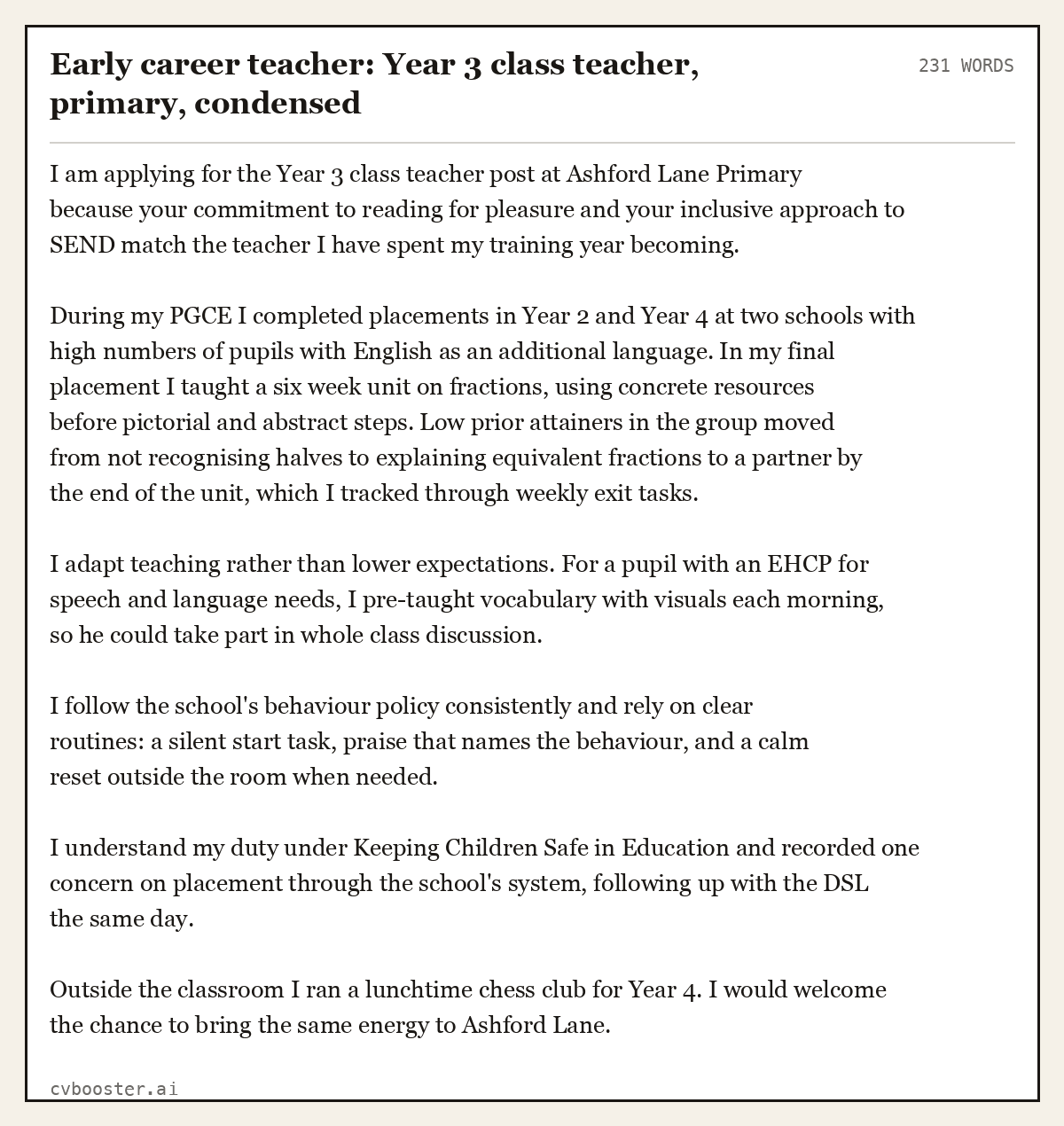
Early career teacher: Year 3 class teacher, primary, condensed (231 words)
I am applying for the Year 3 class teacher post at Ashford Lane Primary because your commitment to reading for pleasure and your inclusive approach to SEND match the teacher I have spent my training year becoming.
During my PGCE I completed placements in Year 2 and Year 4 at two schools with high numbers of pupils with English as an additional language. In my final placement I taught a six week unit on fractions, using concrete resources before pictorial and abstract steps. Low prior attainers in the group moved from not recognising halves to explaining equivalent fractions to a partner by the end of the unit, which I tracked through weekly exit tasks.
I adapt teaching rather than lower expectations. For a pupil with an EHCP for speech and language needs, I pre-taught vocabulary with visuals each morning, so he could take part in whole class discussion.
I follow the school's behaviour policy consistently and rely on clear routines: a silent start task, praise that names the behaviour, and a calm reset outside the room when needed.
I understand my duty under Keeping Children Safe in Education and recorded one concern on placement through the school's system, following up with the DSL the same day.
Outside the classroom I ran a lunchtime chess club for Year 4. I would welcome the chance to bring the same energy to Ashford Lane.
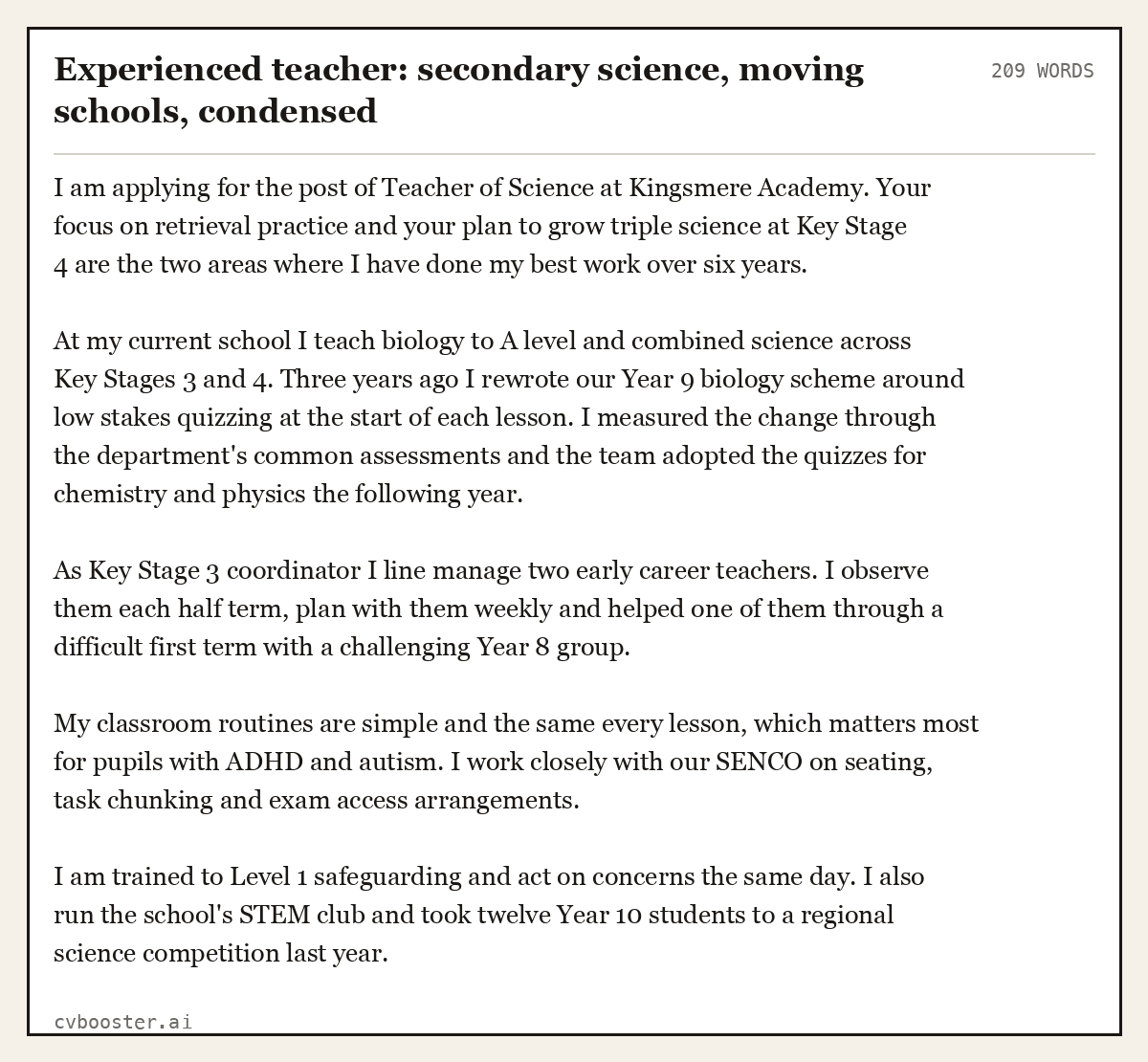
Experienced teacher: secondary science, moving schools, condensed (209 words)
I am applying for the post of Teacher of Science at Kingsmere Academy. Your focus on retrieval practice and your plan to grow triple science at Key Stage 4 are the two areas where I have done my best work over six years.
At my current school I teach biology to A level and combined science across Key Stages 3 and 4. Three years ago I rewrote our Year 9 biology scheme around low stakes quizzing at the start of each lesson. I measured the change through the department's common assessments and the team adopted the quizzes for chemistry and physics the following year.
As Key Stage 3 coordinator I line manage two early career teachers. I observe them each half term, plan with them weekly and helped one of them through a difficult first term with a challenging Year 8 group.
My classroom routines are simple and the same every lesson, which matters most for pupils with ADHD and autism. I work closely with our SENCO on seating, task chunking and exam access arrangements.
I am trained to Level 1 safeguarding and act on concerns the same day. I also run the school's STEM club and took twelve Year 10 students to a regional science competition last year.
Both job statements follow the Teaching Vacancies advice to "show how your experience meets the job description" and to "tailor it to the school or college with specific examples". Neither opens with a love of children. The same guidance gives "I have always wanted to be a teacher. I enjoy working with children and I think I would be good at this role." as the example that needs improvement.
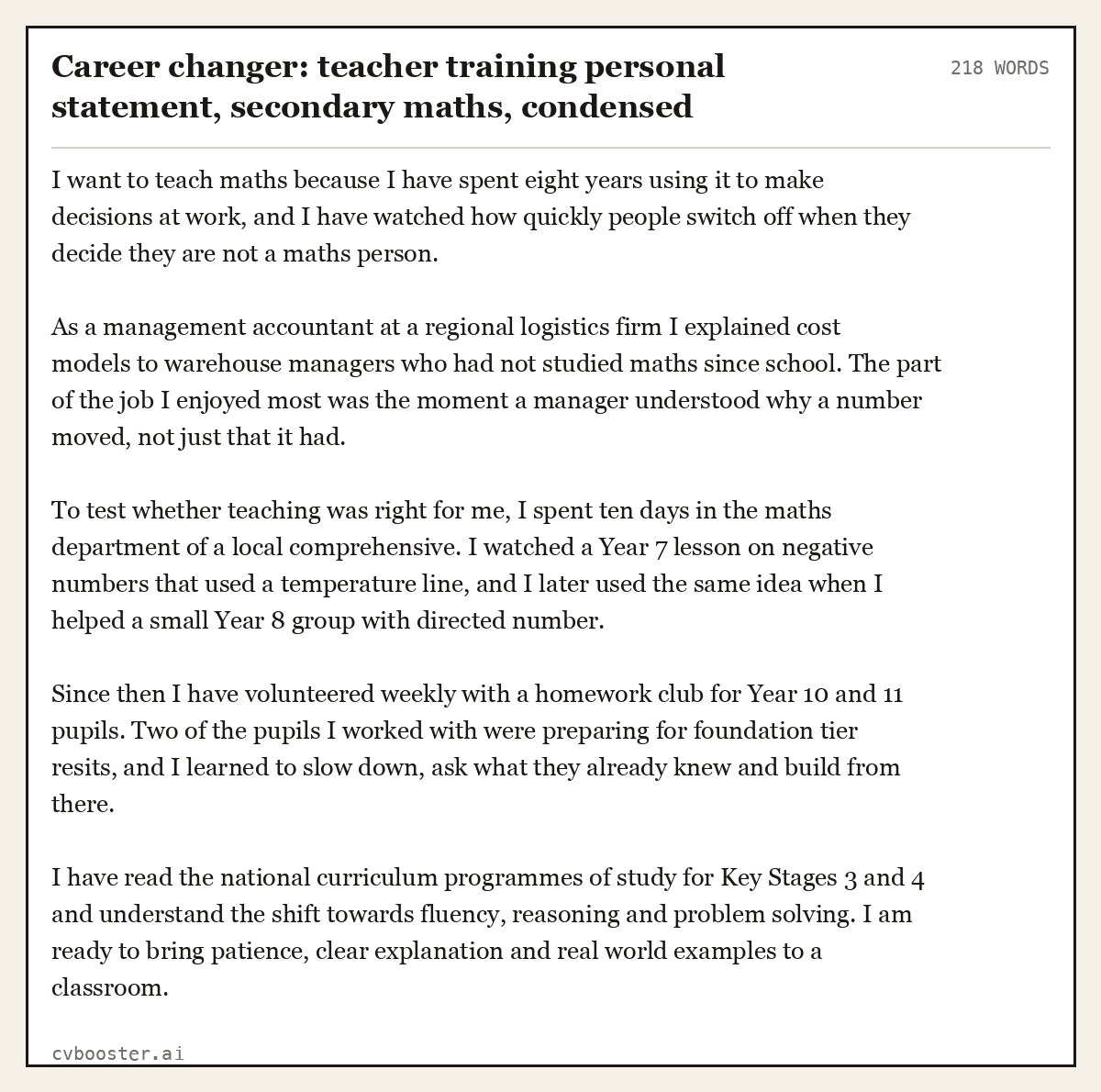
Career changer: teacher training personal statement, secondary maths, condensed (218 words)
I want to teach maths because I have spent eight years using it to make decisions at work, and I have watched how quickly people switch off when they decide they are not a maths person.
As a management accountant at a regional logistics firm I explained cost models to warehouse managers who had not studied maths since school. The part of the job I enjoyed most was the moment a manager understood why a number moved, not just that it had.
To test whether teaching was right for me, I spent ten days in the maths department of a local comprehensive. I watched a Year 7 lesson on negative numbers that used a temperature line, and I later used the same idea when I helped a small Year 8 group with directed number.
Since then I have volunteered weekly with a homework club for Year 10 and 11 pupils. Two of the pupils I worked with were preparing for foundation tier resits, and I learned to slow down, ask what they already knew and build from there.
I have read the national curriculum programmes of study for Key Stages 3 and 4 and understand the shift towards fluency, reasoning and problem solving. I am ready to bring patience, clear explanation and real world examples to a classroom.
The third sample is a different document. A teacher training personal statement goes with a postgraduate application, not a job, and Get Into Teaching says: "Teacher training personal statements can be up to 1000 words." It asks for "evidence of research and understanding of the role of a teacher and the national curriculum", which is why the sample names the programmes of study. If you are applying for a support role rather than a teaching post, the teaching assistant supporting statement example is the closer model.
A skeleton you can fill in tonight
- Opening, three or four lines: the post, your current role and phase or subject, and the one thing in this spec you are answering.
- Subject and curriculum knowledge: what you teach, to which specification, and one example of it changing what pupils could do.
- Planning, assessment and impact: a sequence you designed, the evidence you used, what moved.
- Adaptive teaching and inclusion: named needs, named adjustments, named outcome.
- Behaviour: the policy you worked within, the routines you own, how you handle escalation.
- Safeguarding: your Part one knowledge in practice, in the terms above.
- Wider contribution: clubs, trips, curriculum work, mentoring, parents.
- Close, two or three lines: why this school specifically. No pleading.
Tip: Final check. Every criterion assessed at application appears with evidence attached. No sentence could be pasted into an application for a different school. Employment history runs to month and year and every gap has a reason. Your referees know the form is going in. The file name is your surname plus the post title, not final_v3_actual.docx.
This is worth doing properly because the competition is not. Most statements in the pile are a rewritten personal philosophy with the school name changed. One that walks the person specification line by line, evidences the Teachers Standards without labelling them, and treats safeguarding as knowledge rather than a slogan does not need to be beautifully written. It needs to be tickable.
Related articles
- Cover Letter vs Supporting Statement: UK Rules
- Teaching Interview Questions and 15 Full STAR Answers
- Teaching Assistant Supporting Statement: 3 Full Examples
- Care Worker Supporting Statement Example: 3 Full Statements
More articles
- Technical Interview Questions and 12 Worked Answers
- Technician Certificate on a Resume: 6 Worked Examples
- Technician Resume: The Sections Every Technician Job Checks