What Are Some Weaknesses? 25 Examples for Job Interviews
By Mustafa Tarabya, founder of CVBooster · Published · Updated
9 min read
Some weaknesses you can name in a job interview are delegating too late, saying yes to too much, public speaking, impatience with slow processes, and a skill that sits next to the job rather than at its center. The constraint is that it has to be true and it must not be a core requirement of the role you applied for. Harvard's career center gives the rule: "Try to focus on behaviors, not personality traits". Below are 25 weaknesses by type, the ones to avoid, and seven full answers from first job to manager. Written by Mustafa Tarabya, who hired for his own company, read every application himself and now writes CVBooster's guides.
Your biggest weakness is perfectionism. So was the last candidate's. The room is full of perfectionists and none of them can answer a simple question.
What the weakness question is really testing
The question is not "what is wrong with you". It is a test of whether you can see your own work accurately and do something about what you see. Harvard says these questions are asked "to gauge how much insight you have into yourself and areas where you need improvement."
The UK graduate site targetjobs lists what the recruiter is checking: self-awareness, analytical ability, confidence and honesty. On the last one it is blunt: "Is this really an aspect of your personality or have you just picked an example off the internet?"
So a good answer has three parts:
- The weakness, named plainly. One behavior, not a personality.
- What it cost. A real moment when it caused a problem.
- What you do now, and where it still slips. The fix, plus an honest limit.
Here is the shape in full, for a first job.
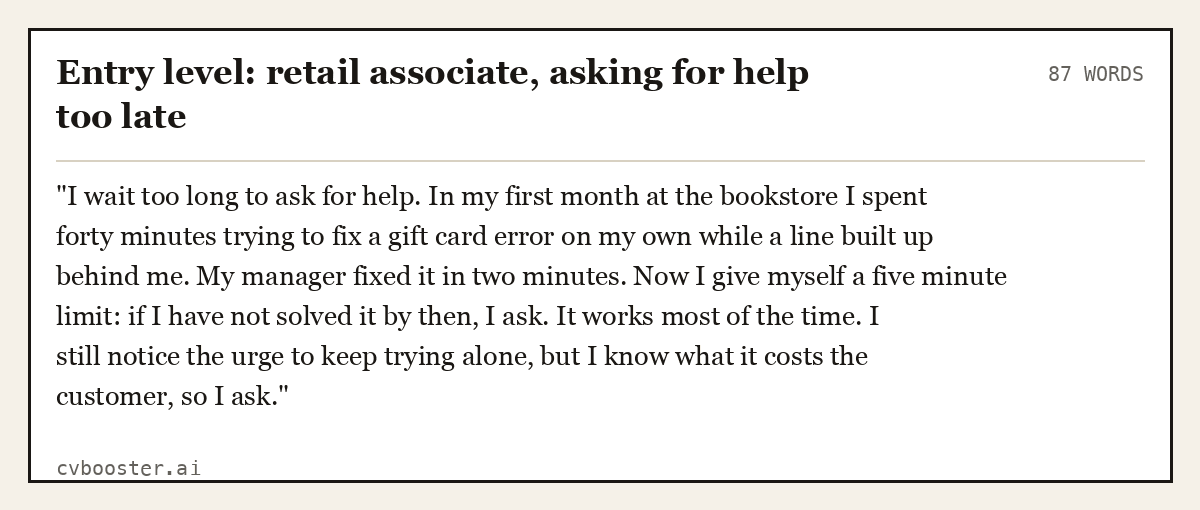
Entry level: retail associate, asking for help too late (87 words)
"I wait too long to ask for help. In my first month at the bookstore I spent forty minutes trying to fix a gift card error on my own while a line built up behind me. My manager fixed it in two minutes. Now I give myself a five minute limit: if I have not solved it by then, I ask. It works most of the time. I still notice the urge to keep trying alone, but I know what it costs the customer, so I ask."
25 examples of weaknesses, by type
Pick from the type that is furthest from what the job depends on. Read the job ad, underline the three things the role needs most, and choose a weakness from outside that list.
Work habits
- Delegating too late, or not at all
- Saying yes to too many requests
- Over-preparing for small tasks
- Leaving the dull admin until the end of the week
- Checking email too often while doing focused work
Communication
- Public speaking to large groups
- Giving direct critical feedback
- Writing emails that are too long
- Speaking up late in meetings
- Asking for help too late
Skills you are still building
- Advanced Excel or data analysis
- A second language at work level
- A specific tool the role does not depend on
- Presenting numbers to senior people
- Negotiating on price
Working style
- Impatience with slow processes
- Taking on other people's problems
- Finding it hard to switch off from unfinished work
- Wanting too much detail before starting
- Being too self-critical after a mistake
Experience gaps
- Limited experience managing people
- No experience in this industry yet
- Little exposure to large budgets
- Working mostly alone, less in large teams
- Limited experience with remote teams
Weaknesses to avoid naming
The UAB Career Center interview handout says three things in a row: "Be honest – everyone has a weakness." Then: do not give a strength in disguise. Then: "Do not state a weakness that is a core qualification for the position."
- Strengths in costume. "I work too hard", "I care too much", "I am a perfectionist". They cannot survive the follow-up question.
- The core of the job. Attention to detail for an accountant. Patient safety for a nurse. Talking to people for a salesperson.
- Character flaws. Dishonesty, lateness, trouble with authority.
- "I can't think of one." It reads as evasion, and it is the one answer that genuinely damages you.
The same weakness, answered badly and well
The weak version protects you from a conversation you were supposed to have. The strong one admits a cost, and that is exactly why it lands.
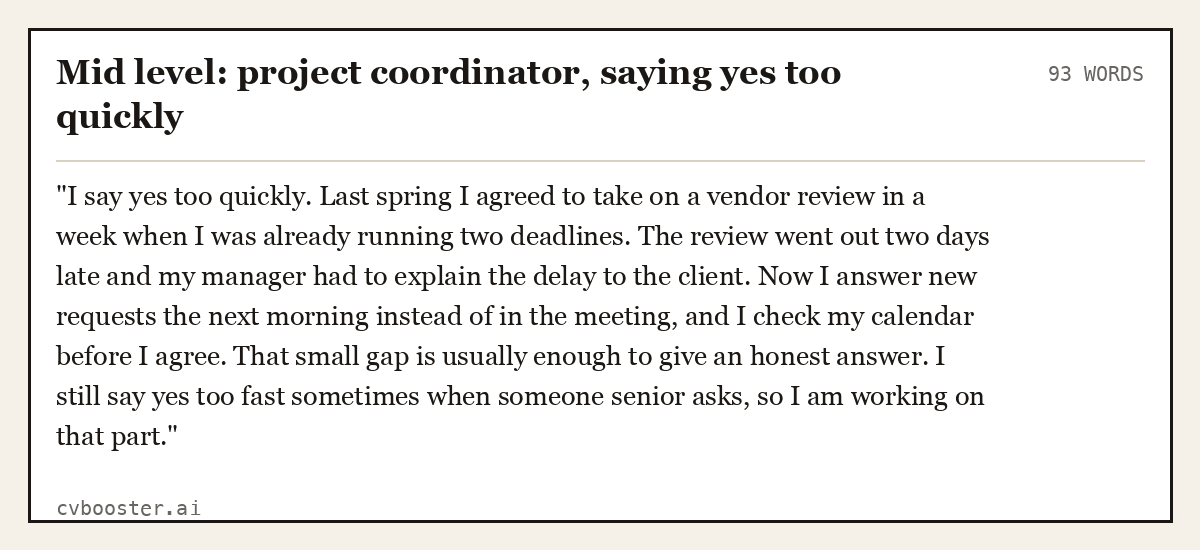
Mid level: project coordinator, saying yes too quickly (93 words)
"I say yes too quickly. Last spring I agreed to take on a vendor review in a week when I was already running two deadlines. The review went out two days late and my manager had to explain the delay to the client. Now I answer new requests the next morning instead of in the meeting, and I check my calendar before I agree. That small gap is usually enough to give an honest answer. I still say yes too fast sometimes when someone senior asks, so I am working on that part."
Notice what the answer risks. It admits a late delivery and a manager covering for it. Most candidates would never say that, which is why it is believable.
Weakness answers for managers and senior roles
At manager level the panel expects a leadership weakness, not a skills gap. The usual honest ones are delegation, feedback and patience. The rest of a manager interview is covered in our leadership interview questions.
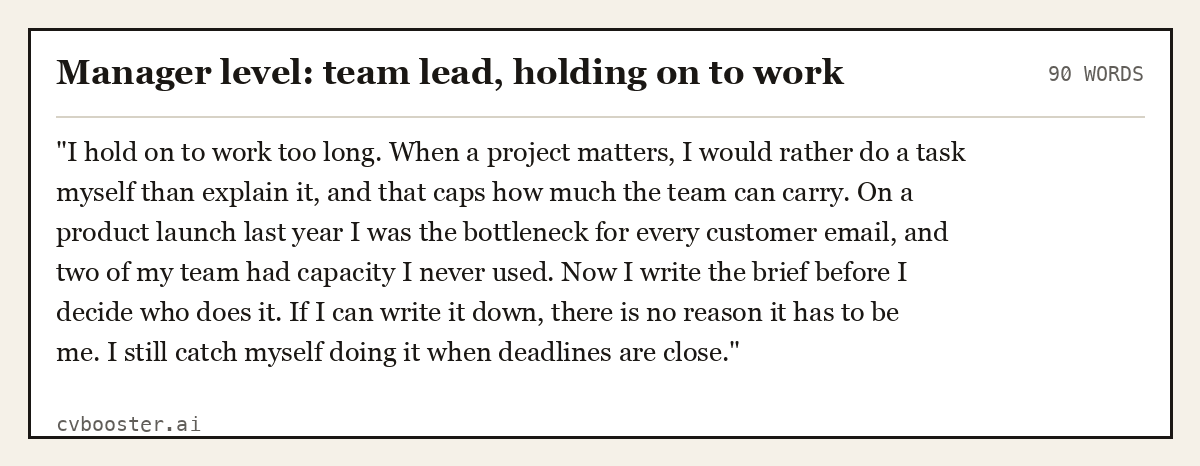
Manager level: team lead, holding on to work (90 words)
"I hold on to work too long. When a project matters, I would rather do a task myself than explain it, and that caps how much the team can carry. On a product launch last year I was the bottleneck for every customer email, and two of my team had capacity I never used. Now I write the brief before I decide who does it. If I can write it down, there is no reason it has to be me. I still catch myself doing it when deadlines are close."
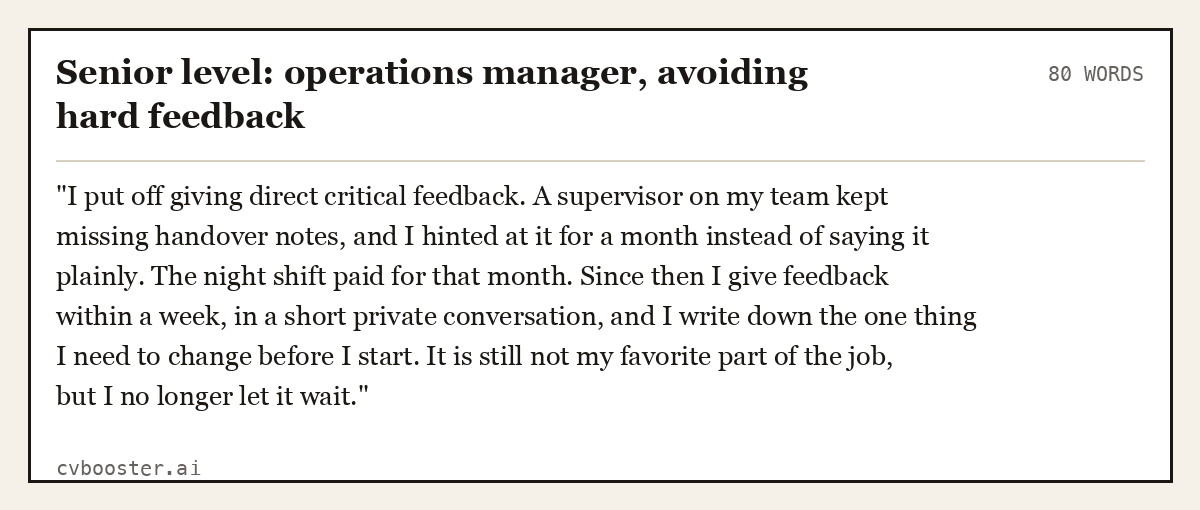
Senior level: operations manager, avoiding hard feedback (80 words)
"I put off giving direct critical feedback. A supervisor on my team kept missing handover notes, and I hinted at it for a month instead of saying it plainly. The night shift paid for that month. Since then I give feedback within a week, in a short private conversation, and I write down the one thing I need to change before I start. It is still not my favorite part of the job, but I no longer let it wait."
Skill gap and communication weaknesses
These work well for early career roles because they come with an obvious fix.
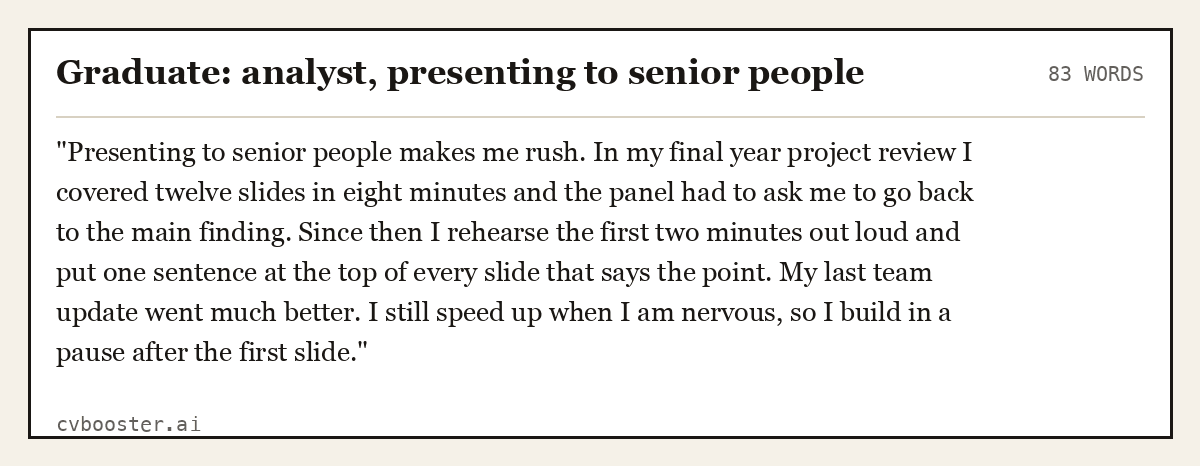
Graduate: analyst, presenting to senior people (83 words)
"Presenting to senior people makes me rush. In my final year project review I covered twelve slides in eight minutes and the panel had to ask me to go back to the main finding. Since then I rehearse the first two minutes out loud and put one sentence at the top of every slide that says the point. My last team update went much better. I still speed up when I am nervous, so I build in a pause after the first slide."
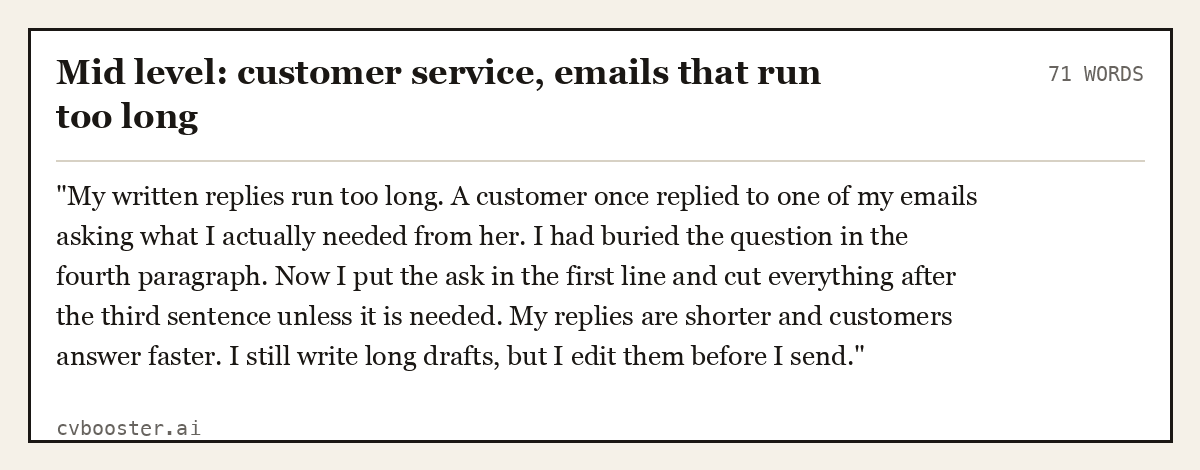
Mid level: customer service, emails that run too long (71 words)
"My written replies run too long. A customer once replied to one of my emails asking what I actually needed from her. I had buried the question in the fourth paragraph. Now I put the ask in the first line and cut everything after the third sentence unless it is needed. My replies are shorter and customers answer faster. I still write long drafts, but I edit them before I send."
Strength and weakness in a nursing interview
Nursing panels ask both questions, often back to back, and they listen for one thing first: patient safety. A weakness that could hurt a patient, such as checking medications too quickly or avoiding difficult conversations with doctors, is the wrong one to name. A weakness about pace, delegation or paperwork is safer. Say the strength first, with a real shift in it.
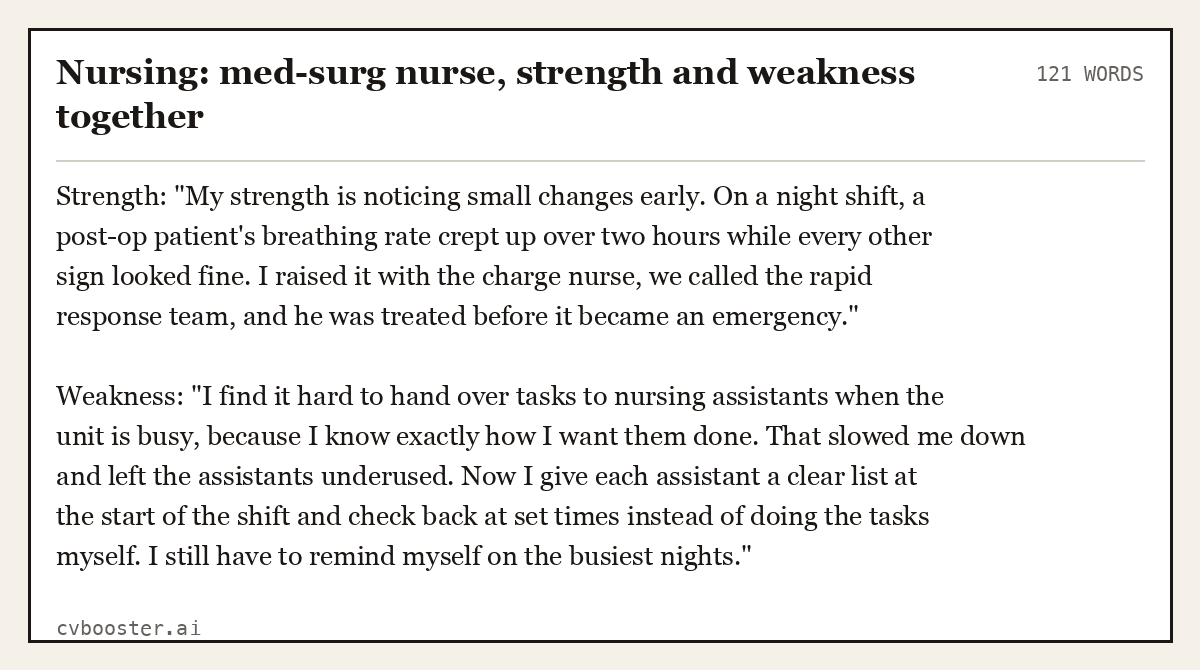
Nursing: med-surg nurse, strength and weakness together (121 words)
Strength: "My strength is noticing small changes early. On a night shift, a post-op patient's breathing rate crept up over two hours while every other sign looked fine. I raised it with the charge nurse, we called the rapid response team, and he was treated before it became an emergency."
Weakness: "I find it hard to hand over tasks to nursing assistants when the unit is busy, because I know exactly how I want them done. That slowed me down and left the assistants underused. Now I give each assistant a clear list at the start of the shift and check back at set times instead of doing the tasks myself. I still have to remind myself on the busiest nights."
Both answers name a real shift, a cost and a change, and neither weakness puts a patient at risk. For the clinical questions that come next, see the emergency nurse interview questions with full sample answers.
The follow-up you should expect
Good interviewers push once. The usual forms are "can you give me a recent example?" and "how did you find out that was a problem?" The questions to ask an interviewee guide shows the same follow-ups from the interviewer's side.
Prepare one specific incident with a consequence and what changed afterwards. If you cannot produce one, you have chosen a weakness you do not actually have. If you freeze, buy time out loud: "Let me give you a real one rather than the rehearsed answer" is a perfectly good sentence.
The same question usually sits next to the strengths question and "tell me about yourself", which are covered in our common interview questions and answers. If the panel wants it in STAR form, use the structure in STAR interview questions.
Frequently asked questions
What are some good weaknesses to say in an interview?
Good weaknesses are real, specific and not central to the job: delegating too late, saying yes too quickly, public speaking, long emails, or a tool the role does not depend on. Name one behavior, give a moment when it caused a problem, then say what you do about it now.
What are 3 weaknesses I can talk about?
Three safe choices for most jobs are asking for help too late, taking on too many requests, and presenting to senior people. Each has a clear cost and a visible fix. Check the job ad first, and drop any of the three that the role depends on.
What should I not say as a weakness?
Avoid strengths in disguise like perfectionism or working too hard, character flaws like lateness or dishonesty, and anything that is a core requirement of the job. Never say you have no weaknesses. Interviewers read that as a refusal to answer, which does more damage than any honest weakness would.
How do you answer the greatest weakness question?
Use three parts: name the weakness as a behavior, describe one real moment when it cost something, then explain what you changed and where it still slips. Keep it under a minute. The honest limit at the end makes the answer believable and holds up when the interviewer asks for an example.
Is it OK to say "I am a perfectionist" as a weakness?
It is rarely a good choice. Interviewers hear it constantly and read it as avoiding the question. If perfectionism is genuinely your issue, describe the behavior instead, such as over-preparing small tasks, and give a real example of the time it cost and what you do differently now.
Related articles
- Leadership Interview Questions and 12 Full Sample Answers
- Case Manager Interview Questions: 7 Answers That Score
- Creative Interview Questions With 6 Sample Answers
- Critical Care Nursing Interview Questions and 9 Answers
More articles
- Well Paid Trades in Australia: 12 Ranked by Real Pay
- Wendy's Interview Questions: Crew and Manager Answers
- What ATS Software Actually Does, and What Resume Tools Get Wrong About It
Looking for a worked example for your job title? Browse the resume examples by job title.