Resume Objective vs Summary: Which to Use, With 8 Examples
By Mustafa Tarabya, founder of CVBooster · Published · Updated
9 min read
In the resume objective vs summary choice, use a summary if you have relevant work experience to point to, and an objective if you are new to the field and need to say what job you are aiming for. The constraint is space: you get one short block at the top, never both, so pick the one that gives the reader a reason to keep going. CareerOneStop, the US Department of Labor's career site, draws the line in one sentence: "A summary statement highlights someone's professional experience, while an Objective overviews what they are seeking in a job." Below are eight examples, checked in October 2026, written as pairs so you can see the same person both ways. Written by Mustafa Tarabya, who hired for his own company, read every application himself and now writes CVBooster's guides.
The quick test: do you have proof to summarize?
Ask one question: do I have work, in this field or close to it, that a manager would care about? If yes, write a summary. If no, write an objective, and make it about the job and the skills you bring, not about what you hope to get.
- Summary: looks back. Your title, your experience, one or two results, the skills the posting asks for. Three to four sentences.
- Objective: looks forward. The role you want, the degree or training you have, the skills you bring to it. One to three sentences.
- Neither: if your experience shows a clear, steady path in one field and space is tight, you can skip the block and let the experience section speak.
CareerOneStop's guide on the top portion of a resume says a summary "highlights your top skills and accomplishments related to the job, using keywords from the job posting," and adds that you can "Skip the Summary section if you don't have much experience (3 years or less), or your work experience shows a clear, consistent progression." In practice, a summary pays off once you have a few years of results to point to; before that, use an objective or let your education and experience open the page.
Examples 1 and 2: recent graduate, objective vs summary
A new graduate usually has no results to summarize yet, so the objective wins. Here is the same person written both ways.
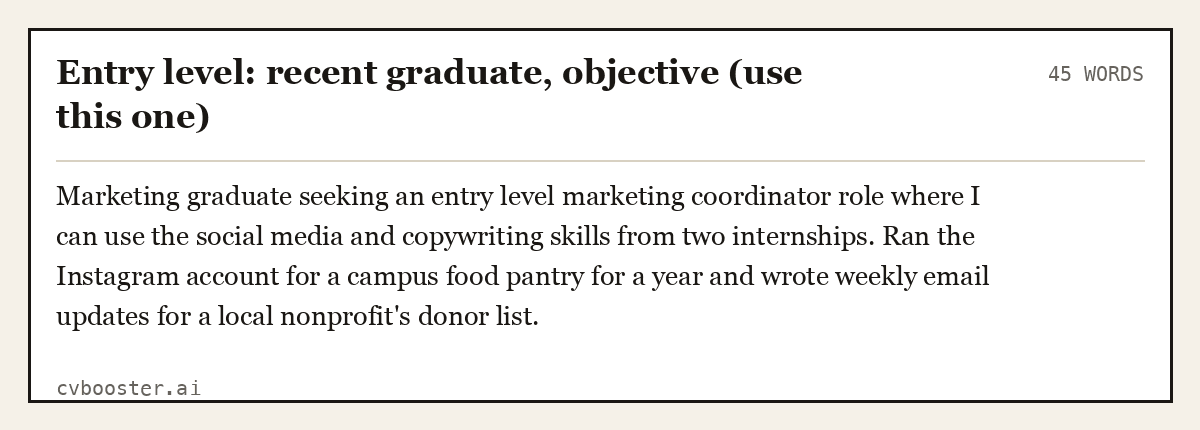
Entry level: recent graduate, objective (use this one) (45 words)
Marketing graduate seeking an entry level marketing coordinator role where I can use the social media and copywriting skills from two internships. Ran the Instagram account for a campus food pantry for a year and wrote weekly email updates for a local nonprofit's donor list.
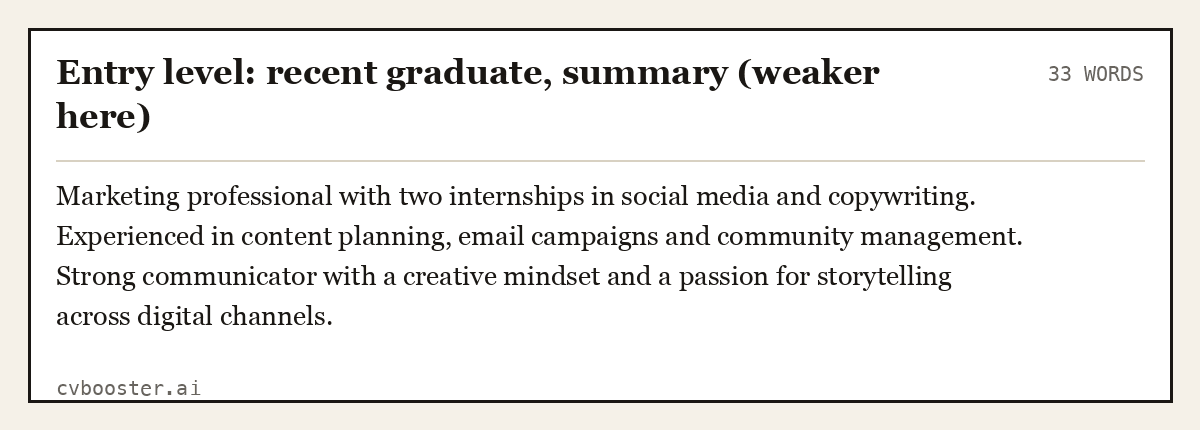
Entry level: recent graduate, summary (weaker here) (33 words)
Marketing professional with two internships in social media and copywriting. Experienced in content planning, email campaigns and community management. Strong communicator with a creative mindset and a passion for storytelling across digital channels.
The summary version claims a professional identity the person does not have yet, and the reader sees through it in the experience section. The objective is honest and still names real work. If you are moving into your first management job, our management objectives resume page has seven objectives written for that step.
Do I need a summary on my resume?
You need a summary on your resume if you have about three years or more of relevant experience and the posting is in the same field. Below that, it is optional, and many readers would rather see your education or your best job straight away. CareerOneStop says you can "Skip the Summary section if you don't have much experience (3 years or less), or your work experience shows a clear, consistent progression." So the honest answer has three branches:
- Yes: you have relevant results, you are applying through an online system that scans for keywords, or your job titles do not explain what you did.
- Optional: you have a steady path in one field and the job titles already tell the story.
- No: you have under three years of work and nothing to summarize yet. Use an objective or start with education.
A summary that only restates your job title in nicer words is worse than no summary, because it takes the best space on the page and gives nothing back.
Do I need an objective on my resume?
You need an objective on your resume only when the reader would otherwise wonder why you applied: you are a new graduate, you are changing fields, or you are returning after a break. If you have experience in the field, you do not need one, and an experienced candidate with an objective looks like someone who has not updated the page in years. For people with little or no work experience applying to entry level jobs in a new field, CareerOneStop's advice is direct: "Replace Summary with Objective at the top of your resume."
Keep it short and make it about the job. Name the role, your degree or training, and one skill or project you bring. The old style objective that says you are "seeking a challenging position with room for growth" is the reason people now ask whether objectives are dead. The specific kind is not.
Examples 3 and 4: career changer, objective vs summary
A career changer has experience, just not in the new field. This is the one case where either can work, and the deciding question is whether your past work transfers in an obvious way.
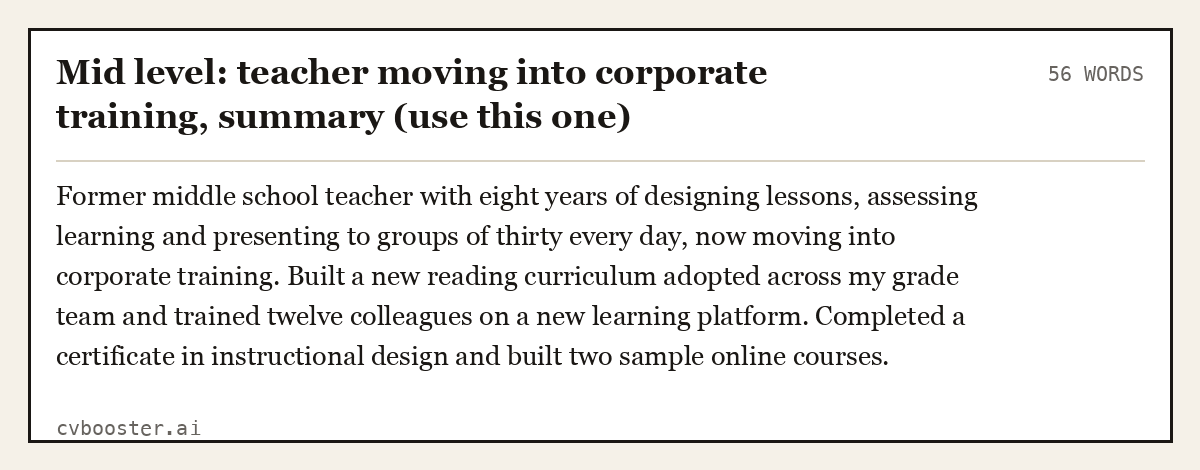
Mid level: teacher moving into corporate training, summary (use this one) (56 words)
Former middle school teacher with eight years of designing lessons, assessing learning and presenting to groups of thirty every day, now moving into corporate training. Built a new reading curriculum adopted across my grade team and trained twelve colleagues on a new learning platform. Completed a certificate in instructional design and built two sample online courses.
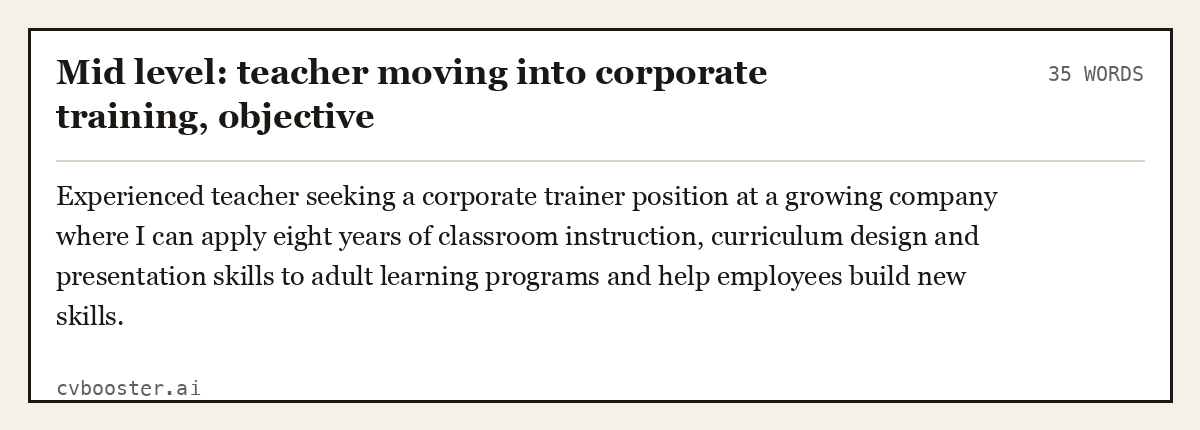
Mid level: teacher moving into corporate training, objective (35 words)
Experienced teacher seeking a corporate trainer position at a growing company where I can apply eight years of classroom instruction, curriculum design and presentation skills to adult learning programs and help employees build new skills.
The summary wins because the teaching work transfers almost word for word. If your old job has little in common with the new one, an objective that names the target role and your new training is the better choice.
Examples 5 and 6: experienced professional, summary vs objective
With five or more years in a field, the objective almost always loses. The employer knows you want the job; that is why you applied.
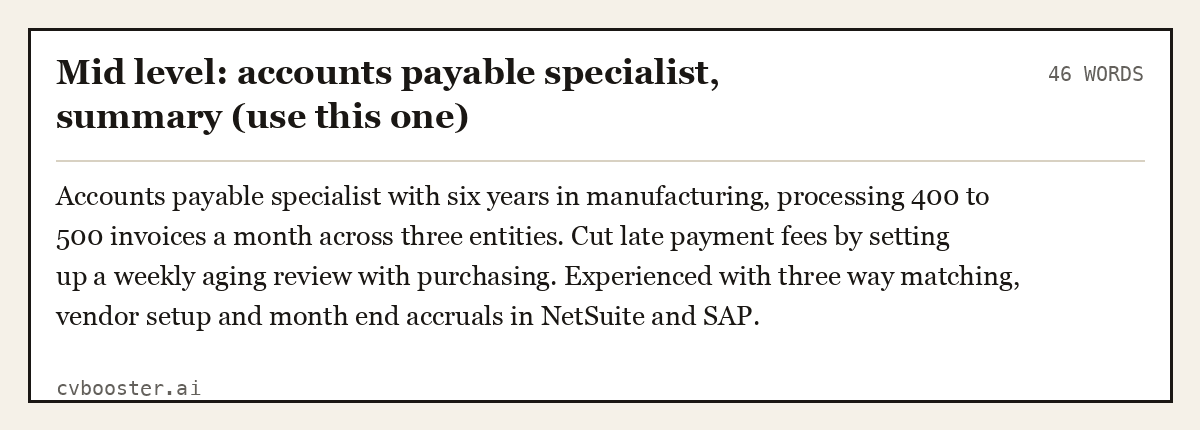
Mid level: accounts payable specialist, summary (use this one) (46 words)
Accounts payable specialist with six years in manufacturing, processing 400 to 500 invoices a month across three entities. Cut late payment fees by setting up a weekly aging review with purchasing. Experienced with three way matching, vendor setup and month end accruals in NetSuite and SAP.
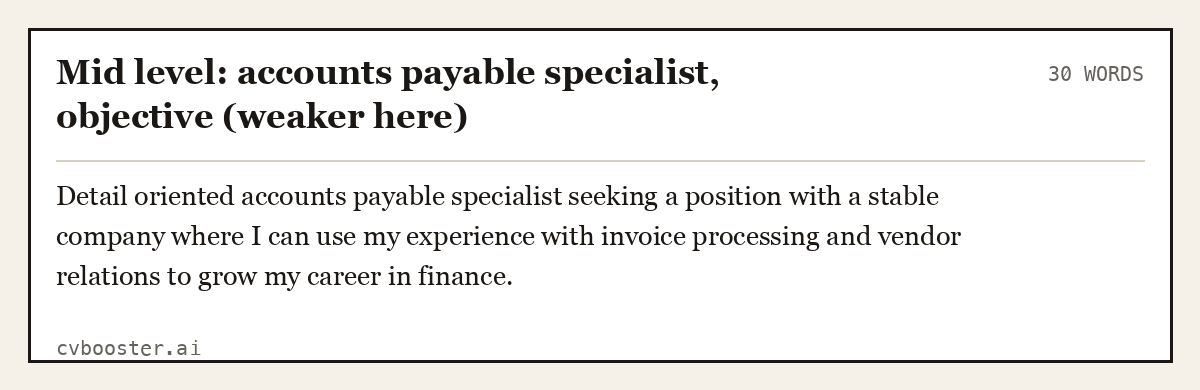
Mid level: accounts payable specialist, objective (weaker here) (30 words)
Detail oriented accounts payable specialist seeking a position with a stable company where I can use my experience with invoice processing and vendor relations to grow my career in finance.
The objective tells the reader what the candidate wants. The summary tells them what they get. For more summaries built this way, see our resume summary examples and the longer guide to a professional summary for a resume.
Examples 7 and 8: senior roles and returners
At senior level, a summary is standard. The one exception is a returner after a long break, where a short objective line inside the summary can explain the move.
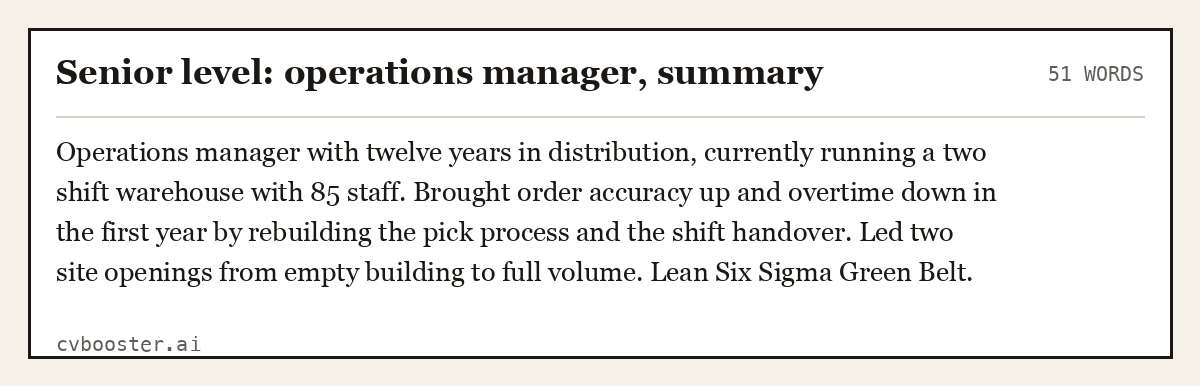
Senior level: operations manager, summary (51 words)
Operations manager with twelve years in distribution, currently running a two shift warehouse with 85 staff. Brought order accuracy up and overtime down in the first year by rebuilding the pick process and the shift handover. Led two site openings from empty building to full volume. Lean Six Sigma Green Belt.
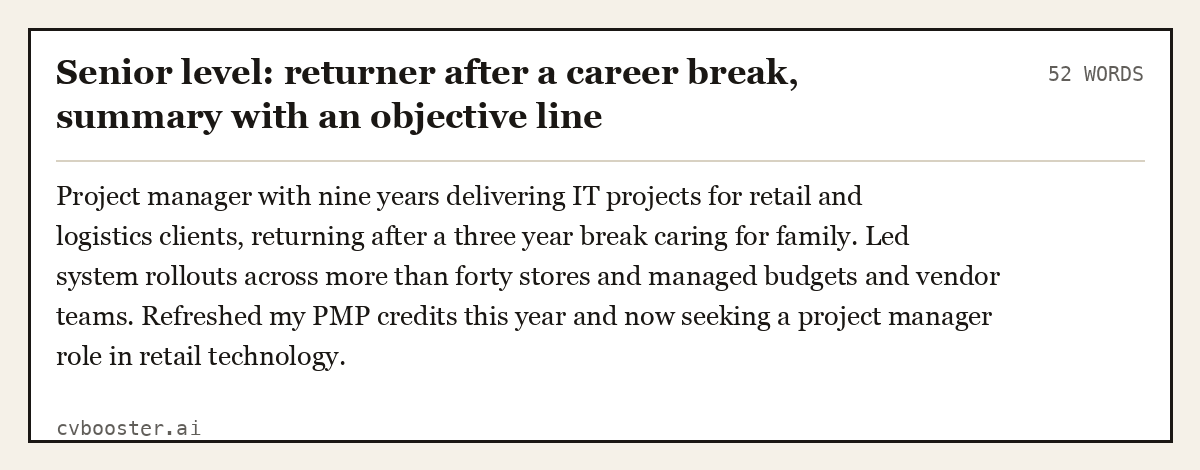
Senior level: returner after a career break, summary with an objective line (52 words)
Project manager with nine years delivering IT projects for retail and logistics clients, returning after a three year break caring for family. Led system rollouts across more than forty stores and managed budgets and vendor teams. Refreshed my PMP credits this year and now seeking a project manager role in retail technology.
The last sentence is the objective, folded into a summary. This hybrid is the right choice whenever you need to explain direction and still want to lead with proof.
How to write either one in three steps
The Department of Labor's free resume guide walks through every other section of the page once the opening block is done.
- Copy the job title and three key skills from the posting.
- For a summary, add your years, your setting and one result with a number you can explain. For an objective, add your degree or training and one real project, internship or volunteer role.
- Cut every adjective that you cannot prove further down the page.
If you are applying for jobs in a particular field, our role guides show objectives by level, such as the CNA objectives for a resume. For a full list of objectives by situation, see the resume objective examples. If you are switching fields, read how to change careers before you decide.
Common mistakes with summaries and objectives
When I read applications for my own company, the opening block decided how carefully I read the rest. An objective that said what the person wanted from me was skimmed. A summary that told me what they had already done got the full page.
- Writing both. Pick one block; two openings push your experience down the page.
- Starting with "I am." Start with your title or your target role.
- Using the same block for every application. Change the title and skills to match each posting.
- Claiming results you cannot discuss. If a number came from a team report you never saw, leave it out.
- Writing about what you want to gain. Even an objective should say what you offer.
Frequently asked questions
Should I use a resume objective or summary?
Use a summary if you have relevant experience with results you can describe. Use an objective if you are a recent graduate, new to the workforce or moving into a field where your past work does not transfer clearly. Never use both blocks on one resume.
Do I need an objective on my resume?
Only if your situation needs explaining: a first job, a change of field or a return after a break. The old style objective that only says what you want is outdated. A short, specific objective that names the role and the skills you bring is still recommended for new graduates, including by the US Department of Labor's CareerOneStop guide.
Do I need a summary on my resume?
Not always. A summary earns its space once you have a few years of relevant results, or when your job titles do not explain what you did. With three years or less of experience, or a steady path in one field, you can skip it and let your education or experience section open the page instead.
Can I combine a summary and an objective?
Yes, as one block. Write a summary of your experience and finish with one sentence about the role you want. This works well for career changers and people returning after a break, and it keeps the top of the page short.
How long should a resume summary or objective be?
A summary is three to four sentences or three to five short bullets. An objective is one to three sentences. Anything longer starts repeating your experience section, which is the part the reader came to see.
What is the difference between a career objective and a professional summary?
A career objective describes the job you are aiming for and the skills you bring to it. A professional summary describes the experience and results you already have. The summary looks back, the objective looks forward.
Related articles
- About Me Examples: 12 Written for a Resume and a Bio
- How to Make a Resume: A Complete Step by Step Guide
- Career Goals on a Resume: Examples & How to Write Them
- Leadership Skills Examples: 12 Skills and the Resume Lines
More articles
- Resume Synonyms: Better Words for 10 Tired Resume Verbs
- Resume in Past Tense or Present: The Rule and 6 Examples
- Resume Translation: How to Translate Your Resume Right
Looking for a worked example for your job title? Browse the resume examples by job title.